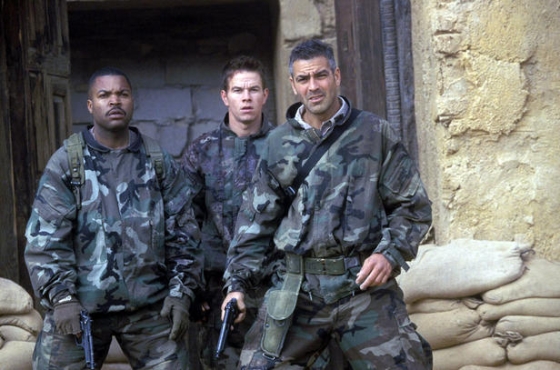
Three Kings (Warner Bros.): Set during Operation Desert Storm this brilliant 1999 drama is the story of four US soldiers (George Clooney, Mark Wahlberg, Ice Cube and Spike Jonze) who loot $23 million in gold hijacked from Kuwait by Saddam Hussein’s army.
The third film from director David O’Russell (after Spanking the Monkey and Flirting With Disaster) was one of the best films of its year, a daring hybrid of Kelly’s Heroes and M*A*S*H featuring some dazzling visuals, fine performances and manages to entertain whilst also making pointed commentary about US foreign policy.
The special features include:
Two audio commentaries: The first is a highly informative track by director David O. Russell who discussing various elements in detail. The second by producers Charles Roven and Edward L. McDonnell and
On the Set of ‘Three Kings’ (21:32)
On the Set of ‘Three Kings’ with Production Designer Catherine Hardwicke (10:15)
The Cinematography of ‘Three Kings:’ An Interview with Director of Photography Newton Thomas Sigel (7:06)
Director David O. Russell’s ‘Three Kings’ Video Journal (13:37)
An Intimate Look Inside the Acting Process with Ice Cube (2:21)
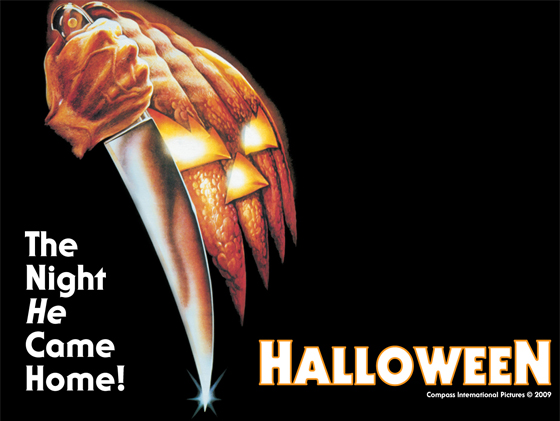
Today is Halloween, which means you can expect trick-or-treaters knocking at your door but also the obligatory screening of John Carpenter’s Halloween.
The 1978 horror classic set the template for modern horror and also became one of the most profitable films of all time.
In honour of its enduring legacy, here are 31 facts about the film:
The film had its origins at the screening of Assault on Precinct 13 at the 1977 London Film Festival, where John Carpenter met financier Moustapha Akkad, who eventually funded the film with his partner, Irwin Yablans.
Assault on Precinct 13 was acquired for distribution in the UK by a man named Michael Myers, the same name of the villain in Halloween.
Originally titled ‘The Babysitter Murders’, it was Yablans who suggested the title and setting of Halloween night.
Akkad was initially concerned about the relative inexperience of Carpenter but he was convinced after the director told him the story verbally (‘almost frame for frame’) and his refusal to take a large fee upfront which showed his confidence in the project.
Carpenter received $10,000 for directing, writing and composing the music and retained rights to 10 percent of the film’s profits.
The film was shot over 21 days in 1978 on a budget of $320,000.
Ironically, it was filmed in April which meant that one of the most famous films set in Autumn was actually shot in Spring.
The out of season weather meant the crew had difficulty finding pumpkins and artificial autumn leaves had to be used for certain scenes.
Many of the the street names in the film were taken from Carpenter’s hometown of Bowling Green, Kentucky.
Donald Pleasance agreed to play Dr. Loomis after Christopher Lee and Peter Cushing turned it down (he met with John Carpenter because his daughter was a fan of Assault on Precinct 13).
It was Jamie Lee Curtis debut feature film and she was paid $8,000 for her role.
Alfred Hitchock’s Psycho was an inspiration: Dr. Loomis’ name was a reference to Sam Loomis (John Gavin), the boyfriend of Marion Crane (Janet Leigh), who in turn is the real-life mother of Jamie Lee Curtis.
The extended P.O.V. shot in the opening scene of the film is heavily influenced by the famous opening of Touch of Evil (1958).
The hands of the young Michael Myers in the opening scene are those of co-writer and producer Debra Hill.
The older version of Michael Myers is actually called ‘The Shape’ in the credits and was played by Nick Castle, an old college friend of Carpenter’s from the University of Southern California. (Actor Tony Moran stood in for Castle in selected scenes).
Because the film was shot out-of-sequence Carpenter would explain to Jamie Lee Curtis what her character’s level of fear should be in certain scenes.
John Carpenter composed the film’s distinctive score himself in just 3 days.
For a slasher film, there is an unusual lack of blood in the film. The only time we see any is when Judith Myers is killed at the beginning and Laurie’s arm is cut near the end.
Dean Cundey’s use of blue back light in the climactic scenes was inspired by watching Roman Polanski’s Chinatown (1974).
The film premièred on October 25th, 1978 in Kansas City, then a platform release in Chicago and New York before word of mouth meant a gradual release around the States.
The film initially grossed $47 million at the US box office and $8 million internationally, which is the equivalent to around $176 million today.
Americans couldn’t actually buy the chilling score when the film came out and it was originally only released in Japan.
When the film made its television debut on NBC in the early 1980s, the network wanted some extra scenes to fill the allotted time slot and Carpenter went back and shot additional sequences during the production of Halloween II (they can be seen on some DVD versions of the film).
In 2006, the film was selected for preservation in the United States National Film Registry by the Library of Congress as being “culturally, historically, or aesthetically significant” .
Financier Moustapha Akkad continued to work act as executive producer on the Halloween franchise, until his death in the 2005 Amman bombings.
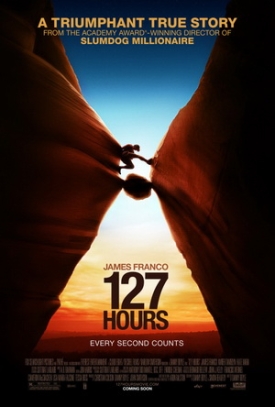
Director Danny Boyle returns from the success of Slumdog Millionaire with a vibrant depiction of man versus nature.
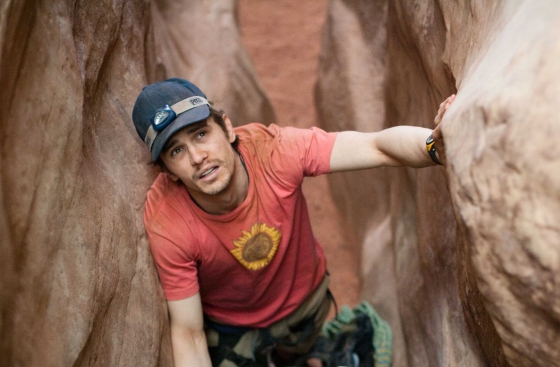
The story here is of Aaron Ralston (played by James Franco), the outdoor enthusiast who in 2003 was stranded under a boulder after falling into a remote canyon in Utah.
Beginning with an extended opening section, Boyle uses a variety of techniques (including split screen, weird angles, quick edits) to express Ralston’s energetic lifestyle as he ventures into a situation that would become ominously static.
He meets two women (Kate Mara and Amber Tamblyn) before parting with them and climbing across an isolated canyon where he becomes trapped for the next 127 hours (look out for a killer title card).
Although it was a widely publicised news story at the time, there is a dilemma when discussing the events of this film.
Some will go in knowing what happened, whilst others will not.
For the benefit of the latter, I’ll refrain from revealing the full details but it is worth noting that the film is not a gory exploration of Ralston’s distress and audiences might be surprised at the overall tone of the film, which is far from gloomy.
An unusual project, in that so much of it revolves around a central location, Boyle contrasts the vital specifics of Ralston’s confinement in the canyon with his interior thoughts as it becomes an increasingly desperate experience.
The details of the situation are expertly realised as a penknife, water bottle, climbing rope and digital camera all assume a vital importance with a large chunk of the film feeling like an existential prison drama.
This gives it a slightly unusual vibe, as the audience is effectively trapped with Ralston in a claustrophobic way.
Using two cinematographers (Anthony Dod Mantle and Enrique Chedia) working in tandem, the ordeal is powerfully realised using a bag of visual tricks to delve deep into his physical and emotional trauma.
Before we get to the canyon, the sun filled landscapes of Utah are shot and edited with a vibrancy and panache recalling some of Boyle’s earlier work, notably Trainspotting and Slumdog Millionaire.
There are also some poetic details that enrich the atmosphere: the distant planes above cutting through the blue sky, insects nonchalantly roaming free and the colour of the rocks themselves which look startling in the sunlight.
Once he actually becomes trapped, a variety of different shots and perspectives help give the situation different visual flavours: the interior of his water bottle, the bone inside his arm and video diary footage on his personal camera, become important in breaking up the gruelling monotony of his predicament.
His interior thoughts are brought to life with memories, flashbacks and hallucinations: a break-up with a girlfriend (Clemence Poesy); visions of his family and childhood; a strange chat-show monologue with himself and a flash flood.
There are times when it feels the filmmakers are over-compensating for the limitations they chose, and more doses of stillness would have been welcome, but overall the visual and audio design helps us get inside Ralston’s physical and emotional situation with clarity and empathy.
But the most brilliant decision of all was the casting of James Franco. His surface charms and hidden depths as an actor provide a perfect fit for the role, as he impressively navigates the emotional ride of his character.
With an unusual amount of screen time he hits all the notes required: exuberant daring as he cycles across Utah; determined ingenuity as he tries to escape the canyon; and the desperate, haunted pain as he stares into the face of death.
A.R. Rahman’s score is a bit looser than his work on Slumdog Millionaire, but it makes for an emotional backdrop to the events on screen and Boyle’s use of songs (notably Free Blood’s ‘Never Hear Surf Music Again’) is effective in cutting together with the images on screen.
Although 127 Hours feels longer than its 93 minute running time (well, it wouldn’t it?), this is actually a sign that Boyle’s gamble in dramatising this material has actually worked.
It is an unusual project in all sorts of ways, eschewing narrative conventions and revelling in its creative rough edges, as it focuses relentlessly on one man’s physical and mental struggle.
There is something in Ralston’s struggle that is both primal and fascinating. Inevitably we ask what we ourselves would have done in the same situation.
But this film version is not just a technical exercise in outdoor survival. It is a reminder of the basic need to survive in the darkest of circumstances.
By the end 127 Hours becomes a transcendent film about the power of life in the face of death.
127 Hours closed the LFF last night and goes on US release on Friday 5th November and in the UK on Friday 7th January.
Saw (3D) (Lionsgate UK): The seventh part of the Saw franchise arrives for its now customary Halloween slot. The story for this instalment involves the battle over Jigsaw‘s ‘brutal legacy’, a group of survivors, and a self-help guru. All in 3D.
Directed by Kevin Greutert, it stars Tobin Bell, Costas Mandylor and even has a returning part for Cary Elwes, who featured in the original film (how long ago that seems). The big questions for this Saw film will be: are audiences burnt out on their yearly dose of torture porn? Will 3D have a positive or negative impact on the box office? I suspect it will do well and that the franchise will be rebooted in some bizarre way because this film series is a cash machine for Lionsgate. [Vue West End & Nationwide / 18]
Burke & Hare (Entertainment): A black comedy about the 19th century grave robbers (played by Simon Pegg and Andy Serkis) who sold bodies to an Edinburgh medical school.
Directed by John Landis, it co-stars Tom Wilkinson, Ronnie Corbett and Tim Curry. Although the period detail is well realised, everyone involved is let down by a poor script, which makes for some awkwardly unfunny sequences, and some dodgy accents which become distracting. The pull of Pegg (a genuine star in the UK) might attract audiences but negative critical buzz and word-of-mouth is likely to hamper the film’s prospects. [Nationwide / 15]
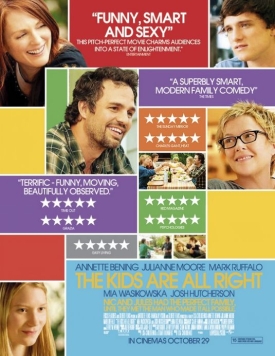
The Kids Are All Right (Universal): A comedy-drama about the complications that ensue when a Los Angeles lesbian couple (Annette Bening and Julianne Moore) discover their two teenage kids (Mia Wasikowska and Josh Hutcherson) have got in touch with their biological father (Mark Ruffalo) it causes various complications.
The third film from writer-director Lisa Cholodenko is a delight: funny, moving and featuring some stellar acting from all concerned. Bening, Moore and Ruffalo are all outstanding whilst Wasikowska and Hutcherson are equally affecting in less showy roles.
Since debuting at Sundance back in January, it has basked in richly deserved critical acclaim for painting a warm and deeply human portrait of family relationships. Word of mouth will be very strong amongst upscale audiences and the likelihood of Oscar nominations will help spread the buzz when the film eventually hits the home market. [Cineworld Haymarket, Curzon Soho, Odeon Covent Gdn. & Nationwide / 15]
Involuntary (Trinity Filmed Entertainment): A Swedish ensemble drama exploring various characters including a man who likes to play salacious pranks; a school teacher and two girls who like pose for photos. Directed by Ruben Östlund , it stars Villmar Björkman, Linnea Cart-Lamy, Leif Edlund and Sara Eriksson [Key Cities / 15]
The Hunter (Artificial Eye): An Iranian drama about a factory worker (Rafi Pitts) who ends up on the run in a nearby forest after something goes wrong. Directed by Pitts, it also stars Ali Nicksaulat, Hassan Ghalenoi, Malek Jahan Khazai and Mitra Hajjar. [Curzon Renoir, Ritzy & Key Cities / 15]
It Happened One Night (Park Circus): Reissue of the Frank Capra film about a pampered socialite (Claudette Colbert) who falls in love with a roguish reporter (Clark Gable). [BFI Southbank & Key Cities]
Forbidden (Park Circus): Another Capra reissue, this is the 1932 melodrama starring Barbara Stanwyck as a librarian who falls for a married man (Adolphe Menjou), with serious consequences. [BFI Southbank & Key Cities]
Out Of The Ashes (Independent Cinema Office): Documentary about the Afghan cricket team and their rise from refugees to the World Cup. Directed by Tim Albone and Lucy Martens. [ICA Cinema & Nationwide]
Spiderhole (Soda Pictures): A British horror film about four students who end up having problems in a seemingly deserted house in London. [Empire Leicester Square & Key Cities]
This Prison Where I Live (Dogwoof): A documentary about the imprisoned Burmese comedian Zarganar, who was imprisoned in 2008 for 35 years after complaining about the government’s response to cyclone Nargis. [Ritzy Picturehouse]
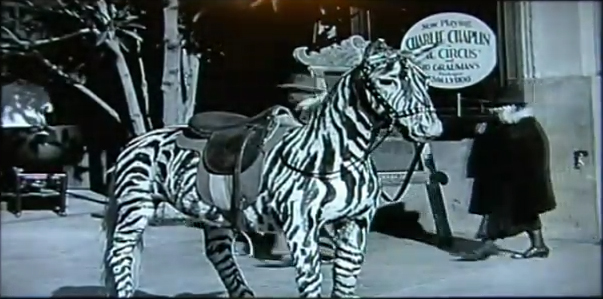
A video showing something unusual in Charlie Chaplin’s 1928 film ‘The Circus‘ has gone viral on the web.
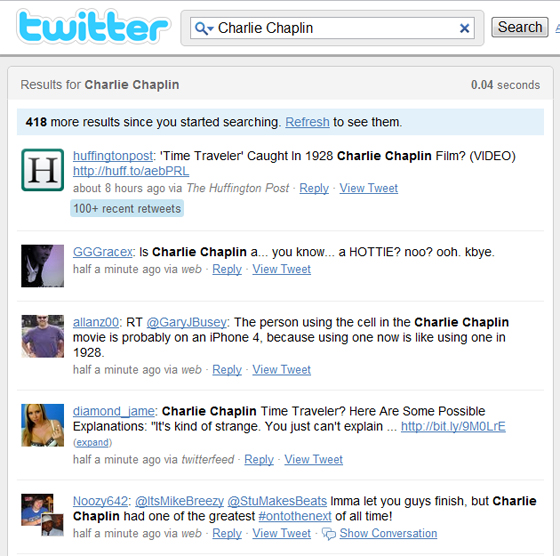
Earlier today I noticed that ‘Charlie Chaplin’ was trending on Twitter – not exactly the first online destination I would associate with the great silent comedian.
It turns out all the fuss was about a YouTube video which has amassed over 1.5 million views.
Posted by George Clarke from Belfast, it shows a woman in the Chaplin film holding something to her head.
It’s likely the actor is holding a hearing aid, but that hasn’t stopped the video from amassing more than two million views on YouTube.
I’m sure the fact that some Charlie Chaplin DVDs are released in a couple of weeks is a total and utter coincidence (notice he mentions the name of the DVD label).
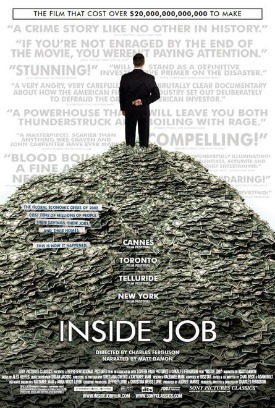
Charles Ferguson’s documentary explores the global financial crisis with devastating clarity and paints a deeply troubling picture of the relationship between financial and political elites.
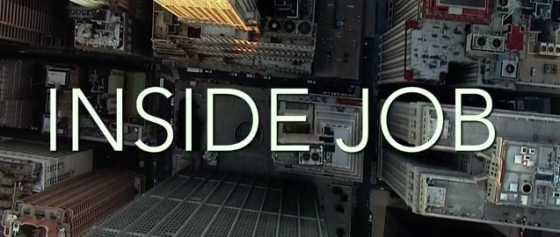
Within the space of just two hours, using interviews, graphics, impressive editing and a sober narration from Matt Damon, Inside Job takes us through the causes of the current economic meltdown.
Although a lot of the information presented here has been explored in other books and TV programmes (such as the BBC’s The Love of Money), to see it presented in a single film is both constructive and chilling.
Ferguson himself cross-examines a number of government and private sector officials – though many of the key culprits refused to be interviewed – and his probing questions elicit some revealing requests to stop filming when they appear unexpectedly thrown by certain questions.
One startling aspect of the film is how much academics, supposedly independent from Wall Street banks, are actually paid by them for opinions or even serve on their boards – a clear conflict of interest which several of them appear oblivious to.
Using a sober tone throughout, the narration, interview footage and graphics all collate and explain the financial jargon of CDOs, credit default swaps and the policies which left much of the public scratching their head as they tried to process the full extent of what happened.
But this is more than just an academic primer: featuring widescreen lensing, aerial shots of New York and some appropriate music (the opening credits feature Peter Gabriel’s ‘Big Time’) it is a cinematic experience, which visually reflects the gravity of the subject.
The relentless approach is both appropriate and effective, although it also reveals some ghoulish comedy when exploring the widespread use of cocaine and prostitutes on Wall St and the stuttering angst of interviewees caught out by Ferguson’s well-researched questions.
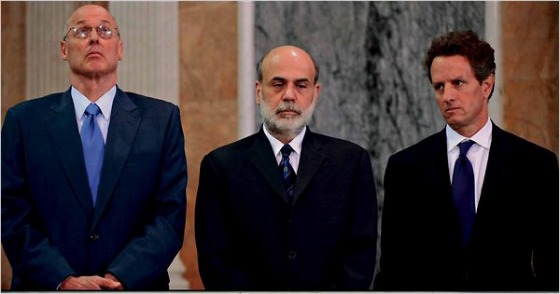
The revolving door connecting the political and financial worlds, along with figures such as Henry Paulson, Lawrence Summers and Robert Rubin, has effectively shielded large banks from any effective regulation.
But this was essentially socialism for the rich, in which the public paid the price for the irresponsible actions of political and financial elites.
Inside Job might appear to be an incendiary title, but it is wholly appropriate: two years on from the averted meltdown, there appears to be no meaningful financial reform and the governments appear to have little taste for prosecuting those who helped cause the crisis.
Could the embattled Obama administration, currently suffering because of the economic collapse, find renewed energy in restoring the financial regulations lost over the last thirty years?
Bringing those responsible for the fraud that triggered trillions of dollars in losses would certainly be a vote winner, even if the Wall Street backlash was severe.
That may or may not happen, but in the mean time this documentary is a worthy call to arms: in examining the root causes of the crisis and emphasising the importance of restoring honesty to the global financial system, it is one of the most important films of the year.
Inside Job screened tonight (Oct 27th) and plays tomorrow (October 28th) at the London Film Festival.
It is currently out in the US in limited release and opens in the UK on February 18th February 2011
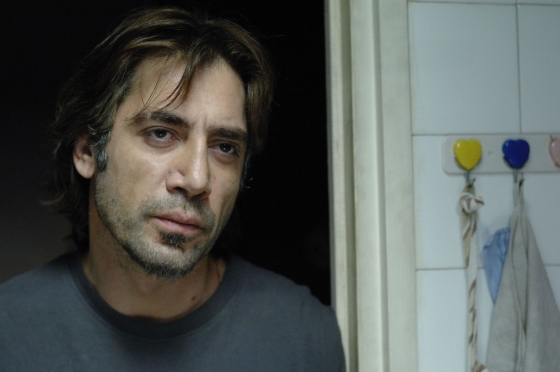
A powerful depiction of life on the edges of a modern city, the latest film from Alejandro González Iñárritu is a full on experience featuring a dazzling central performance by Javier Bardem.
Marking a break from his triptych of films with screenwriter Guillermo Arriaga, Biutiful is the more linear tale of Uxbal (Bardem), a father struggling in the slums of contemporary Barcelona.
A fixer of sorts for illegal immigrant labour in the city, he sets up jobs, smoothes over ‘relations’ with the local police and deals with various figures involved in this hidden economy, including his brother Tito (Eduard Fernandez) and business partner Hai (Taisheng Cheng).
He is also a devoted father to his children, Ana (Hanaa Bouchaib) and Mateo (Guillermo Estrella), and in addition to caring for them, struggles to cope with his bipolar ex-wife, Marambra (Maricel Alvarez) and an immigrant Senegalese woman (Diaryatou Daff) he feels responsible for.
There is more to the story and clocking in at 138 minutes, Iñárritu doesn’t hold back in showing us a kaleidoscope of problems as Uxbal deals with health issues, emotional anxieties and a deep sense of his own mortality.
The film’s grim milieu is expertly realised and, to its great credit, doesn’t shy away from showing the stark reality of a modern metropolis built on cheap labour and the suffering of the poor.
Rodrigo Prieto’s handheld camerawork captures the exterior and interior worlds of Barcelona with remarkable authenticity, and there are shifts in aspect ratio and camera speeds which add to the rich visual architecture of the film.
Stephen Mirrione’s editing is another standout element, stitching the action together with considerable skill – one sequence involving the police chasing an immigrant gang is a masterclass in construction and pacing.
The sound design by Martin Hernandez is also highly effective, used to accentuate the reality of Uxbal’s world but also employing unconventional effects to take us inside his mind.
After the globetrotting nature of Babel, Innaritu seems to have become more interested in a single place and a central, unifying character who acts as a nexus for the themes and events of the story.
Uxbal is an intriguing protagonist of considerable contradictions: he uses people, whilst also helping them; is angry but loving with those closest to him; and appears to be both resigned to and in denial about his ultimate fate.
The character is brought vividly to life by an incredible central performance by Javier Bardem: in addition to his magnetic screen presence, he convinces as a shady, underworld operator but also conveys his interior emotions with remarkable grace and authenticity.
It is one of the most affecting portrayals of fatherhood I can remember seeing on screen: the chemistry with his children is touchingly real and the emotional latter stages are almost hard to watch.
But whilst Bardem dominates the film, other actors also leave their mark: as Uxbal’s ex-wife, Alvarez convincingly alternates between her moods; and as their children Bouchaib and Estrella display a realism and maturity rare amongst young actors.
Iñárritu is a director who likes to deal with big themes on a wide canvas, which can run the risk of seeming grandiose or self-important.
But Biutiful – the title comes from a misspelling within the story – is admirable precisely because it tackles huge subjects with an unusual intensity and a refreshing lack of distance or irony.
Although he seems to be returning to similar themes in his films – love, death, existence – Iñárritu has considerable skills as a filmmaker and uses his full armoury to open these subjects up for the audience to process.
Not everything works – a diversion into the supernatural is perhaps a step too far – but the barrage of elements presented is wildly ambitious and admirable for its naked, emotional quality.
In exploring life in a modern city through one character he manages to find something universal in the particulars of a man’s life and it ends up being more than just a supercharged retelling of the Book of Job.
Biutiful is not a film that will please everyone or reach a massive audience, but it features one of the great modern screen performances and in exploring the rawness of existence, reaches a level of transcendence rare in modern cinema.
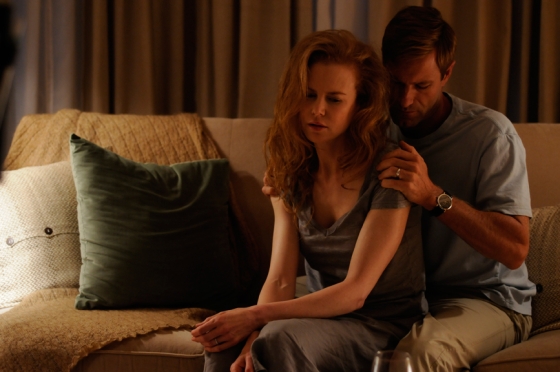
The upcoming drama Rabbit Hole stars Nicole Kidman and Aaron Eckhart as a couple dealing with a sudden loss and is directed by John Cameron Mitchell from a script by David Lindsay-Abaire, adapted from his Pulitzer Prize-winning play.
It opens in the US on December 17th and a UK release is TBC
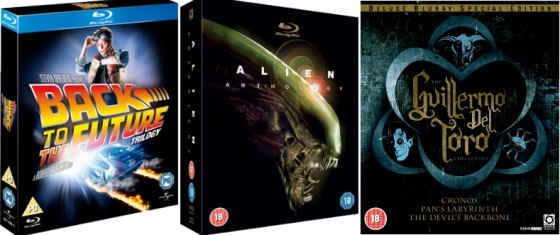
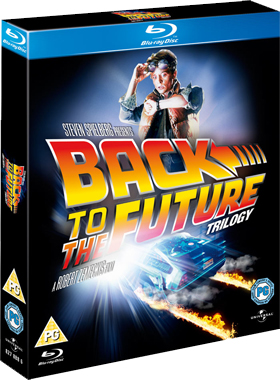
Back to the Future Trilogy (Universal): The time-travel comedy trilogy gets released on Blu-ray for the first time and Universal have put together a package which does full justice to these inventive and much loved films.
A lot of viewers will be pleasantly surprised how good a job Universal has done with the audio and visual transfer (screenshots can be seen here) and it certainly gives them an added kick if you haven’t seen them in a while. But for most people the reason for getting this box set will be the huge array of extras detailing the production. [Read the full review here]
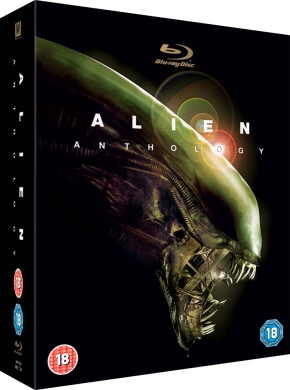
Alien Anthology (20th Century Fox): Although this is essentially a Blu-ray upgrade from the previous Alien Quadrilogy boxset, that was one of the best boxsets in living memory.
However, the HD transfers for Alien (1979) and Aliens (1986) have been done with considerable care and attention and there is extra material which will be of interest to fans of the series.
James Cameron personally oversaw the new transfer of Aliens, the audio for Alien 3 has been upgraded with Charles Dance and Lance Henriksen recording new dialogue and there is a previously unreleased ‘Alien 3′ documentary which features visual evidence of the nightmare David Fincher had on the set of his directorial debut. [Read the full review here]
The Guillermo Del Toro Trilogy (Optimum): Mexican director Guillermo Del Toro is recognised as one of the world’s most visually inventive directors, balancing a career torn between films such as Hellboy with smaller, personal projects such as the three films brought together in this collection – The Devil’s Backbone (2001), Pan’s Labyrinth (2006) and his debut feature, Cronos (1993).
Special Features include:
UK Exclusive interview with Guillermo Del Toro
Exclusive pages from Guillermo Del Toro’s The Strain Trilogy
Brand new interviews
Featurettes
Motion Comics
Early short film Geomtria
Sketches and storyboards
Galleries
Trailers
ALSO OUT
13 Hrs (High Fliers Video Distribution) [Blu-ray / Normal] 8 Mile (UCA) [Blu-ray / Normal] A Nightmare On Elm Street (Warner Home Video) [Blu-ray / with DVD and Digital Copy] Baby Mama (UCA) [Blu-ray / Normal] Billy Madison (Universal Pictures) [Blu-ray / Normal] Bulletproof (UCA) [Blu-ray / Normal] D-Tox (UCA) [Blu-ray / Normal] Dante’s Peak (Universal Pictures) [Blu-ray / Normal] Dead Silence (Universal Pictures) [Blu-ray / Normal] Dinosaurs Alive! (Cornerstone Media Int.) [Blu-ray / with 3D Version] First Blood/Cliffhanger/Lock Up (Optimum Home Entertainment) [Blu-ray / Box Set] Happy Gilmore (Universal Pictures) [Blu-ray / Normal] Hard Rain (Universal Pictures) [Blu-ray / Normal] Iron Man 1 and 2 (Paramount Home Entertainment) [Blu-ray / Normal] Iron Man 2 (Paramount Home Entertainment) [Blu-ray / Normal] Killers (Lionsgate UK) [Blu-ray / Normal] Leatherheads (UCA) [Blu-ray / Normal] Make Way for Tomorrow (Eureka) [Blu-ray / Normal] Mercury Rising (Universal Pictures) [Blu-ray / Normal] Scent of a Woman (Universal Pictures) [Blu-ray / Normal] Smallville: Season 9 (Warner Home Video) [Blu-ray / Normal] Spirits of the Dead (Arrow Films) [Blu-ray / Normal] Star Wars – The Clone Wars: Season 2 (Warner Home Video) [Blu-ray / Normal] Taking Woodstock (UCA) [Blu-ray / Normal] The Break Up (Universal Pictures) [Blu-ray / Normal] The Express (UCA) [Blu-ray / Normal] The Game (Universal Pictures) [Blu-ray / Normal] The Holiday (Universal Pictures) [Blu-ray / Normal] The Interpreter (Universal Pictures) [Blu-ray / Normal] The Jackal (Universal Pictures) [Blu-ray / Normal] The Skeleton Key (Universal Pictures) [Blu-ray / Normal] Total Recall/Raw Deal/Red Heat (Optimum Home Entertainment) [Blu-ray / Box Set] True Legend (Optimum Home Entertainment) [Blu-ray / Normal] Waist Deep (UCA) [Blu-ray / Normal] We Own the Night (Universal Pictures) [Blu-ray / Normal] Wild at Heart (Universal Pictures) [Blu-ray / Normal] Will Success Spoil Rock Hunter? (Eureka) [Blu-ray / Normal] You, Me and Dupree (Universal Pictures) [Blu-ray / Normal]
A perfectly pitched comedy-drama about family tensions, director Lisa Cholodenko’s third film is also a showcase for some stellar acting.
When a Los Angeles lesbian couple, Nic (Annette Bening) and Jules (Julianne Moore), discover their two teenage kids, Joni (Mia Wasikowska) and Laser (Josh Hutcherson), have got in touch with their biological father (Mark Ruffalo) it causes various complications.
As with Chodolenko’s previous films, this is very much a character piece exploring the intricacies and complications of human relationships.
But it is a step up from her last two films, applying a light touch to potentially heavy issues, and much of the enjoyment comes from the actors fitting snugly into their roles, especially the two leads who have their best parts in years.
Bening is excellent as the career-orientated matriarch. As an uptight, wine-loving physician she manages to convey a genuine warmth and affection for her family that often seems hidden beneath her surface anxieties.
Moore gets to explore a more vulnerable side, as someone less interested in a career and who strays of the beaten track in looking for someone to spice up her domestic routine.
The chemistry between the two is striking and they paint a convincing picture of a genuinely loving couple who are nonetheless susceptible to the insecurities and problems of everyday life.
Already attracting awards season buzz, it will be interesting to see which categories both actresses are submitted for. At the moment the smart money is for Bening, but it seemed to me that Moore had slightly more screen time.
In the key supporting roles, Wasikowska and Hutcherson provide a nice contrast to their parents with their charming levelheadedness, whilst Ruffalo exudes a relaxing, easy charm as the man who is a catalyst for unexpected change.
The screenplay, by Cholodenko and Stuart Blumberg, manages to flesh out the characters and impressively depicts underlying tensions, be they of gender, sexuality or background.
Perhaps the most striking aspect of the film is how purely enjoyable it is to watch, moving from scene-to-scene with witty dialogue and organic humour generated from the interaction of the well-drawn characters.
This has the added bonus of dramatic moments arriving with unexpected force and when they do, it is with a lack of bombast unusual for films dealing with relationship problems.
For an independent film, albeit an upscale one, the look and feel of the production is convincing and special credit must go to editor Jeffrey M. Werner who helps move scenes along with an understated ease and fluency.
Added to this is an excellent soundtrack, which seems to reflect the different tastes of the family: for the parents there is David Bowie, Joni Mitchell and The Who, whilst for the kids, we get tracks from Vampire Weekend and MGMT.
Comedy-dramas (or dramatic comedies) can often be a hellish thing to get right, but here Chodolenko strikes just the right balance, with a tone that never takes its characters too seriously, whilst still treating them with respect.
Although the issue of gay marriage is still a contentious one in America, this film goes a long way in putting forward the idea that a happy family doesn’t have to be a conventional one.
Without resorting to grandstanding polemic and instead just showing the bittersweet ups and downs of a loving family, Chodolenko has made a convincing case that the kids will indeed be alright.
The Kids Are Alright screens at the London Film Festival (Monday 25th, Tues 26th and Weds 27th) and opens in the UK on Friday 30th October
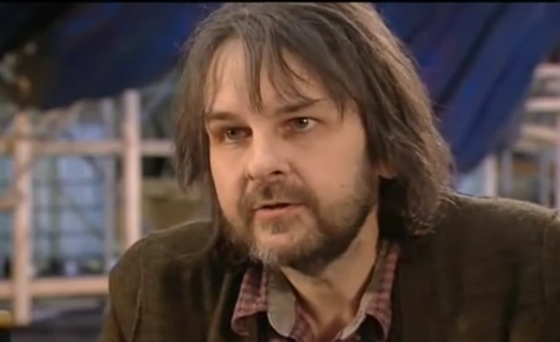
Peter Jackson recently gave a lengthy interview about whether or not upcoming film version of The Hobbit will be filmed in New Zealand.
Speaking to TV New Zealand he gave his side of a dispute which involves local acting unions who threatened to boycott the production.
Guillermo del Toro was initially going to direct but left the project in May (due to delays caused by MGM’s financial situation) and Jackson replaced him in July.
Ian McKellen, Andy Serkis, and Hugo Weaving, who all appeared in in The Lord of the Rings trilogy, will reprise their roles, even though the films are a prequel.
Alien Anthology (20th Century Fox): Although essentially a Blu-ray upgrade from the previous Alien Quadrilogy boxset, that was one of the best in living memory, so the added extras make this one worthwhile.
The dilema with purchasing the Alien series in one package is that the first two films are outstanding and the next two are, for different reasons, interesting failures (the less said about the AVP films, the better).
However, the HD transfers for Alien (1979) and Aliens (1986) have been done with considerable care and attention and there is extra material which will be of interest to fans of the series.
James Cameron personally oversaw the new transfer of Aliens, the audio for Alien 3 has been upgraded with Charles Dance and Lance Henriksen recording new dialogue and there is a previously unreleased ‘Alien 3’ documentary which features visual evidence of the nightmare David Fincher had on the set of his directorial debut.
A lot of the interviews are new and extended and Mark Kermode’s excellent ‘Alien Evolution’ documentary is included in an uncut, complete version.
There is also the interactive MU-TH-UR mode, which lets you tag and bookmark topics across the discs and access them later.
The full features breakdown like this:
DISCS
4 film discs
Two versions of each movie (Directors Cut or Special Edition & Theatrical Version) in High Definition, plus commentaries
2 discs of Bonus Material
Over 60 hours of extra features, including every piece of bonus material ever released
Including over 4 hours of NEVER BEFORE SEEN content
New MU-TH-UR Mode, a fully interactive companion takes the extensive materials in the ALIEN ANTHOLOGY and puts them in the user’s hand – connecting fans to special features on all six discs and instantly providing an index of all available ALIEN content.
SPECIAL FEATURES
DISC ONE: ALIEN
1979 Theatrical Version
2003 Director’s Cut with Ridley Scott Introduction
Audio Commentary by Director Ridley Scott, Writer Dan O’Bannon, Executive Producer Ronald Shusett, Editor Terry Rawlings, Actors Sigourney Weaver, Tom Skerritt, Veronica Cartwright, Harry Dean Stanton and John Hurt
Audio Commentary (for Theatrical Cut only) by Ridley Scott
Final Theatrical Isolated Score by Jerry Goldsmith
Composer’s Original Isolated Score by Jerry Goldsmith
Deleted and Extended Scenes
MU-TH-UR Mode Interactive Experience with Weyland-Yutani Datastream
DISC TWO: ALIENS
1986 Theatrical Version
1991 Special Edition with James Cameron Introduction
Audio Commentary by Director James Cameron, Producer Gale Anne Hurd, Alien Effects Creator Stan Winston, Visual Effects Supervisors Robert Skotak and Dennis Skotak, Miniature Effects Supervisor Pat McClung, Actors Michael Biehn, Bill Paxton, Lance Henriksen, Jenette Goldstein, Carrie Henn and Christopher Henn
Final Theatrical Isolated Score by James Horner
Composer’s Original Isolated Score by James Horner
Deleted and Extended Scenes
MU-TH-UR Mode Interactive Experience with Weyland-Yutani Datastream
DISC THREE: ALIEN3
1992 Theatrical Version
2003 Special Edition (Restored Workprint Version)
Audio Commentary by Cinematographer Alex Thomson, B.S.C., Editor Terry Rawlings, Alien Effects Designers Alec Gillis and Tom Woodruff, Jr., Visual Effects Producer Richard Edlund, A.S.C., Actors Paul McGann and Lance Henriksen
Final Theatrical Isolated Score by Elliot Goldenthal
Deleted and Extended Scenes
MU-TH-UR Mode Interactive Experience with Weyland-Yutani Datastream
DISC FOUR: ALIEN RESURRECTION
1997 Theatrical Version
2003 Special Edition with Jean-Pierre Jeunet Introduction
Audio Commentary by Director Jean-Pierre Jeunet, Editor Hervé Schneid, A.C.E., Alien Effects Creators Alec Gillis and Tom Woodruff, Jr., Visual Effects Supervisor Pitof, Conceptual Artist Sylvain Despretz, Actors Ron Perlman, Dominique Pinon and Leland Orser
Final Theatrical Isolated Score by John Frizzell
Deleted and Extended Scenes
MU-TH-UR Mode Interactive Experience with Weyland-Yutani Datastream
DISC FIVE: MAKING THE ANTHOLOGY
In addition to over 12 hours of in-depth documentaries, these Blu-ray box set has nearly five hours of additional video ‘Enhancement Pods’, presenting behind-the-scenes footage, raw dailies and interview outtakes from all four films. At topical points in the documentaries, you can access these pods to enhance your experience, or watch them on their own from the separate Enhancement Pod index.
The Beast Within: Making ALIEN
Star Beast: Developing the Story
The Visualists: Direction and Design
Truckers in Space: Casting
Fear of the Unknown: Shepperton Studios, 1978
The Darkest Reaches: Nostromo and Alien Planet
The Eighth Passenger: Creature Design
Future Tense: Editing and Music
Outward Bound: Visual Effects
A Nightmare Fulfilled: Reaction to the Film
Enhancement Pods
Superior Firepower: Making ALIENS
57 Years Later: Continuing the Story
Building Better Worlds: From Concept to Construction
Preparing for Battle: Casting and Characterization
This Time It’s War: Pinewood Studios, 1985
The Risk Always Lives: Weapons and Action
Bug Hunt: Creature Design
Beauty and the Bitch: Power Loader vs. Queen Alien
Two Orphans: Sigourney Weaver and Carrie Henn • The Final Countdown: Music, Editing and Sound
The Power of Real Tech: Visual Effects
Aliens Unleashed: Reaction to the Film
Enhancement Pods
Wreckage and Rage: Making ALIEN3
Development Hell: Concluding the Story
Tales of the Wooden Planet: Vincent Ward’s Vision
Stasis Interrupted: David Fincher’s Vision
Xeno-Erotic: H.R. Giger’s Redesign
The Color of Blood: Pinewood Studios, 1991
Adaptive Organism: Creature Design
The Downward Spiral: Creative Differences
Where the Sun Burns Cold: Fox Studios, L.A. 1992
Optical Fury: Visual Effects
Requiem for a Scream: Music, Editing and Sound
Post-Mortem: Reaction to the Film
Enhancement Pods
One Step Beyond: Making ALIEN RESURRECTION
From the Ashes: Reviving the Story
French Twist: Direction and Design
Under the Skin: Casting and Characterization
Death from Below: Fox Studios, Los Angeles, 1996
In the Zone: The Basketball Scene
Unnatural Mutation: Creature Design
Genetic Composition: Music
Virtual Aliens: Computer Generated Imagery
A Matter of Scale: Miniature Photography
Critical Juncture: Reaction to the Film
Enhancement Pods
MU-TH-UR Mode Interactive Experience to Access and Control Enhancement Pods
DISC SIX: THE ANTHOLOGY ARCHIVES
ALIEN
Pre-Production
First Draft Screenplay by Dan O’Bannon
Ridleygrams: Original Thumbnails and Notes
Storyboard Archive
The Art of Alien: Conceptual Art Portfolio
Sigourney Weaver Screen Tests with Select Director Commentary
Cast Portrait Gallery
Production
The Chestbuster: Multi-Angle Sequence with Commentary
Video Graphics Gallery
Production Image Galleries
Continuity Polaroids
The Sets of Alien
H.R. Giger’s Workshop Gallery
Post-Production and Aftermath
Additional Deleted Scenes
Image & Poster Galleries
Experience in Terror
Special Collector’s Edition LaserDisc Archive
The Alien Legacy
American Cinematheque: Ridley Scott Q&A
Trailers & TV Spots
ALIENS
Pre-Production
Original Treatment by James Cameron
Pre-Visualizations: Multi-Angle Videomatics with Commentary
Storyboard Archive
The Art of Aliens: Image Galleries
Cast Portrait Gallery
Production
Production Image Galleries
Continuity Polaroids
Weapons and Vehicles
Stan Winston’s Workshop
Colonial Marine Helmet Cameras
Video Graphics Gallery
Weyland-Yutani Inquest: Nostromo Dossiers
Post-Production and Aftermath
Deleted Scene: Burke Cocooned
Deleted Scene Montage
Image Galleries
Special Collector’s Edition LaserDisc Archive
Main Title Exploration
Aliens: Ride at the Speed of Fright
Trailers & TV Spots
ALIEN3
Pre-Production
Storyboard Archive
The Art of Arceon
The Art of Fiorina
Production
Furnace Construction: Time-Lapse Sequence
EEV Bioscan: Multi-Angle Vignette with Commentary
Production Image Galleries
A.D.I.’s Workshop
Post-Production and Aftermath
Visual Effects Gallery
Special Shoot: Promotional Photo Archive
Alien3 Advance Featurette
The Making of Alien3 Promotional Featurette
Trailers & TV Spots
ALIEN RESURRECTION
Pre-Production
First Draft Screenplay by Joss Whedon
Test Footage: A.D.I. Creature Shop with Commentary
Test Footage: Costumes, Hair and Makeup
Pre-Visualizations: Multi-Angle Rehearsals
Storyboard Archive
The Marc Caro Portfolio: Character Designs
The Art of Resurrection: Image Galleries
Production
Production Image Galleries
A.D.I.’s Workshop
Post-Production and Aftermath
Visual Effects Gallery
Special Shoot: Promotional Photo Archive
HBO First Look: The Making of Alien Resurrection
Alien Resurrection Promotional Featurette
Trailers & TV Spots
ANTHOLOGY
Two Versions of Alien Evolution
The Alien Saga
Patches and Logos Gallery
Aliens 3D Attraction Scripts and Gallery
Aliens in the Basement: The Bob Burns Collection
Parodies
Dark Horse Cover Gallery
Patches and Logos Gallery
MU-TH-UR Mode Interactive Experience
SUBTITLES AND AUDIO
Alien
Theatrical Audio: English 5.1 DTS HD Master Audio, English 4.1 Dolby Surround, English 2.0 Dolby Surround, Brazilian Portuguese 5.1 Dolby Digital, French 5.1 DTS, German 5.1 DTS, Latin Spanish 5.1 Dolby Digital
Theatrical Subtitles: English for the hearing impaired, Brazilian Portuguese, Danish, Finnish, French, German, Latin Spanish, Dutch, Norwegian, Swedish
Extended Audio: English 5.1 DTS HD Master Audio, English 2.0 Dolby Surround, Brazilian Portuguese 5.1 Dolby Digital, French 5.1 DTS, German 5.1 DTS, Latin Spanish 5.1 Dolby Digital
Extended Subtitles: English for the hearing impaired, Brazilian Portuguese, Danish, Finnish, French, German, Latin Spanish, Dutch, Norwegian, Swedish
Aliens
Theatrical Audio: English 5.1 DTS HD Master Audio, English 4.1 Dolby Surround, English 2.0 Dolby Surround, Brazilian Portuguese 5.1 Dolby Digital, French 5.1 DTS, German 5.1 DTS, Latin Spanish 5.1 Dolby Digital
Theatrical Subtitles: English for the hearing impaired, Brazilian Portuguese, Danish, Finnish, French, German, Latin Spanish, Dutch, Norwegian, Swedish
Extended Audio: English 5.1 DTS HD Master Audio, English 2.0 Dolby Surround, Brazilian Portuguese 5.1 Dolby Digital, French 5.1 DTS, German 5.1 DTS, Latin Spanish 5.1 Dolby Digital
Extended Subtitles: English for the hearing impaired, Brazilian Portuguese, Danish, Finnish, French, German, Latin Spanish, Dutch, Norwegian, Swedish
Alien 3
Theatrical Audio: English 5.1 DTS HD Master Audio, Brazilian Portuguese 5.1 Dolby Digital, French 5.1 DTS, German 5.1 DTS, Latin Spanish 5.1 Dolby Digital
Theatrical Subtitles: English for the hearing impaired, Brazilian Portuguese, Danish, Finnish, French, German, Latin Spanish, Dutch, Norwegian, Swedish
Restored Work Print Version Audio: English 5.1 DTS HD Master Audio, Brazilian Portuguese 5.1 Dolby Digital, French 5.1 DTS, German 5.1 DTS, Latin Spanish 5.1 Dolby Digital
Restored Work Print Version Subtitles: English for the hearing impaired, Brazilian Portuguese, Danish, Finnish, French, German, Latin Spanish, Dutch, Norwegian, Swedish
Alien Resurrection
Theatrical Audio: English 5.1 DTS HD Master Audio, Brazilian Portuguese 5.1 Dolby Digital, French 5.1 DTS, German 5.1 DTS, Latin Spanish 5.1 Dolby Digital
Theatrical Subtitles: English for the hearing impaired, Brazilian Portuguese, Danish, Finnish, French, German, Latin Spanish, Dutch, Norwegian, Swedish
Extended Audio: English 5.1 DTS HD Master Audio, Brazilian Portuguese 5.1 Dolby Digital, French 5.1 DTS, German 5.1 DTS, Latin Spanish 5.1 Dolby Digital
Extended Subtitles: English for the hearing impaired, Brazilian Portuguese, Danish, Finnish, French, German, Latin Spanish, Dutch, Norwegian, Swedish
Alien Anthology is out now from 20th Century Fox Home Entertainment
Back to the Future Trilogy (Universal): The time-travel comedy trilogy gets released on Blu-ray for the first time and Universal have put together a package which does full justice to these inventive and much loved films.
Directed by Robert Zemeckis, the first film was the tale of high school student Marty McFly (Michael J. Fox) who accidentally travels back 30 years in time after an eccentric scientist (Christopher Lloyd) builds a time machine which strands him in 1955.
There he inadvertently interferes with the romance of his then teenage parents: nerdy father (Crispin Glover) and mother (Lea Thompson), whilst also having to deal with Biff (Thomas F. Wilson), Marty’s dad’s bullying supervisor.
The story, written by Zemeckis and Bob Gale, then becomes a race to reunite his parents-to-be and find a way of getting back to 1985.
An instant critical and commercial hit on its release in the summer of 1985, it launched Fox as a movie star and established Zemeckis as an A-list director.
The inventive premise, smart humour and excellent performances still shine and it has aged remarkably well, appealing to a new generation of audiences.
In retrospect, some of the comedy is surprisingly daring: it is difficult to imagine a studio comedy today featuring gags about terrorists (“the Libyans!”), potential incest (“are you telling me that my mom …has the hots for me?!”) and Ronald Regan (“who is the Vice-president in 1985? Jerry Lewis?).
Despite those more daring undercurrents, it is one of those rare mainstream films that genuinely appeals to audiences of all ages, combining innocence, invention and a great central premise which makes older and younger audiences think whilst they laugh.
The sequels, shot back-to-back, were not as good as the original but certainly had their moments.
The second film, which picked up precisely where they left off, saw Marty and Doc Brown travel to 2015 to fine-tune the future, only to cause havoc with the space time continuum, which they have to repair by going back to 1955 again.
One can only imagine the hoops Zemeckis and Gale had to jump through in writing the follow up – they hadn’t initially planned one – and their screenplay ingeniously interacts with the events of the first film.
Another impressive aspect, sometimes overlooked, is the visual effects, which are used to create multiple characters from the same actor, as well as painting a detailed picture of the future.
Made in 1989 on the cusp of the CGI revolution ushered in by The Abyss, Terminator and Jurassic Park, the visual effects still hold up well.
The third film, released in 1990 saw Marty (Michael J. Fox) travel back to 1885 in order to rescue Doc Brown (Christopher Lloyd) before he becomes smitten with a schoolteacher (Mary Steenburgen).
Cleverly referencing the first two films, it doesn’t quite match up to them but is still an amiable and entertaining end to the series.
A lot of viewers will be pleasantly surprised how good a job Universal has done with the audio and visual transfer (screenshots can be seen here) and it certainly gives them an added kick if you haven’t seen them in a while.
But for most people the reason for getting this box set will be the huge array of extras detailing the production.
The supplements duplicate all the extras from the previous DVD releases, including commentaries, but also feature a lot of brand new material, principally Tales from the Future, a 6 part, 2 hour documentary in HD.
The whole package is spread over 3 Blu-ray discs and there are brand new interviews with Michael J. Fox, Christopher Lloyd, Lea Thompson, director Robert Zemeckis, producers Bob Gale and Neil Canton, plus executive producer Steven Spielberg.
There is also a digital copy of each film for playback on a portable device.
SPECIAL FEATURES
(*Denotes new footage debuting on the 25th Anniversary Trilogy Blu-ray)
Tales from the Future: New six-part retrospective documentary featuring interviews with Michael J. Fox, Christopher Lloyd, Lea Thompson, Director Robert Zemeckis, Producers Bob Gale and Neil Canton, plus Executive Producer Steven Spielberg.*
In the Beginning . . .: Delve into the genesis of the project, casting, re-casting, the DeLorean, sets and overall pre-production.
Time to Go: Production stories through the release of the first film.
Keeping Time: The score and the songs of the Back to the Future Trilogy.
Time Flies: Learn more about how the sequel came about, the futuristic look, the special and visual effects, recreating 1955 and more.
Third Time’s the Charm: Learn about building a western town, Doc Brown’s love story, the casting of Mary Steenburgen, the train sequence and completing the Trilogy.
The Test of Time: Back to the Future becomes a phenomenon! President Reagan quotes the film, the Back to the Future ride opens at Universal Studios theme park and fans rebuild the iconic DeLorean. The film’s cast and crew take a look back and discuss why these beloved movies live on.
The Physics of Back To The Future: A discussion with celebrity best-selling author and physicist Dr. Michio Kaku about the overall appreciation of the science in the Back to the Future Trilogy*
Nuclear Test Site Ending Storyboard Sequence: Storyboard sequence of the original proposed ending of the film.*
16 Deleted Scenes
Michael J. Fox Q&A
Q&A Commentaries with Director Robert Zemeckis and Producer Bob Gale
Feature Commentaries with Producers Bob Gale and Neil Canton
Making the Trilogy: Chapters One, Two & Three: Original 2002 DVD documentary that takes a look back in time.The Making Of Back to the Future Part I, II & III: Provides a vintage and historic look at the making of all three films.
The Secrets of the Back to the Future Trilogy: a televised special hosted by Kirk Cameron addressing fans unanswered Back to the Future questions.
Back to the Future Night: Hosted by Leslie Nielsen, this original 30-minute special aired on NBC prior to the first television screening of the Back to the Future.
Behind-the-Scenes Outtakes
Original Makeup Tests
Production Design
Storyboarding
Designing the DeLorean
Designing Time Travel
Hoverboard Test
Designing Hill Valley
Designing the Campaign
Back to the Future: The Ride
Music Videos: Huey Lewis and the News “Power of Love” / ZZ Top “DoubleBack”
Photo Galleries, Including Production Art, Additional Storyboards, Photographs, Marketing Materials and Character Portraits
Theatrical Trailers
* There is also a Special Collector’s Edition featuring a Delorean blueprint, Outtatime number plate, Sports Almanac, Save The Clocktower poster, and a Lenticular photo of Marty’s family 8
INTERACTIVE BLU-RAY BONUS FEATURES *
U-CONTROL: Universal’s exclusive feature allows viewers to learn more about their favorite film without ever leaving the movie.
Setups & Payoffs: As you watch each of the three films, each “set up” showcases items in the scene that prepare you for a future plot point. When you get to that moment in the film, the “payoff” is shown.
Storyboard Comparison: Compare key scenes in the movie with the original storyboards.
Trivia Track: Get inside trivia and facts while you watch the movies.
BD-LIVE: Access the BD-LiveTM Centre through your Internet-connected player to get even more content, watch the latest trailers and more!
My Scenes: Bookmark your favourite scenes from the movies.
pocket BLU™: Universal’s groundbreaking pocket BLU app uses iPhone®, iPod® touch, iPad®, Blackberry®, Android™, Windows and Macintosh computers and more to work seamlessly with a network-connected Blu-rayTM player and offers advanced features such as: o Advanced Remote Control: A sleek, elegant new way to operate your Blu-ray™ player. Users can navigate through menus, playback and BD-Live™ functions with ease.
Video Timeline: Users can easily bring up the video timeline, allowing them to instantly access any point in their favorite episode.
Mobile-To-Go: Users can unlock a selection of bonus content with their Blu-ray™ discs to save to their device or to stream from anywhere there’s a Wi-Fi network, enabling them to enjoy exclusive content on the go, anytime, anywhere.
Browse Titles: Users will have access to a complete list of pocket BLU™-enabled titles available and coming to Blu-ray™. They can view free previews and see what additional content is available to unlock on their device.
Keyboard: Enter data into a Blu-ray™ player with your device’s easy and intuitive keyboard.
The Back to the Future Trilogy is out on Monday 25th October from Universal Home Entertainment
In this interview with Written By magazine editor Richard Stayton for the WGA, he talks about his early writing days and adapting the Joseph Conrad novel Heart of Darkness for Francis Ford Coppola.
In addition to writing the screenplays for films such as Magnum Force, Big Wednesday and Conan the Barbarian, he was also the inspiration for Walter Sobchak (played by John Goodman) in The Big Lebowski.
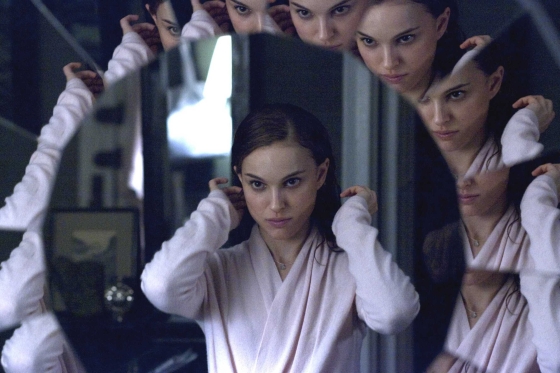
Darren Aronofsky’s portrait of an obsessive ballerina is wonderfully intense experience, powered by a standout performance from Natalie Portman.
Set amongst a New York City ballet company producing Swan Lake, it focuses on the psychological and physical tribulations of Nina (Portman), a dancer desperate to impress her demanding director (Vincent Cassel) and possessive mother (Barbara Hershey).
After she wins the lead role we see Nina’s ambition and drive turn into something much darker.
She begins to have suspicions about her predecessor (Winona Ryder), a fellow dancer (Mila Kunis) and herself as she becomes burdened with all kinds of psychological and physical problems.
Incorporating a variety of influences that include The Red Shoes, Repulsion and David Cronenberg, it also riffs heavily on the raw source material of Swan Lake itself.
Tchaikovsky’s original work is given a modern day twist, as the trials of a young princess turned into a swan by an evil sorcerer get unsettling and often surprising parallels.
At one point Cassel’s director says of his staging of Swan Lake:
“It’s been done to death, I know, but not like this. We’re going to strip it down and make it visceral and real”
This might also be Aronofsky talking, as that is exactly what he does with Black Swan.
Clint Mansell’s score also emphasises this, expanding on Tchaikovsky’s original compositions but taking it to a more sinister place, which, allied with some highly effective sound design, makes for an arresting audio backdrop.
Intriguing parallels with The Wrestler abound: both examine the physical and mental costs of being a performer; show the pressures of ageing; feature a character’s desire to connect; and climax with a grand flourish.
Black Swan goes further in cranking up the tension and, along with a paranoid, unreliable narrator, there is an unusual amount of visual effects shots that depict the crumbling reality of Nina’s world.
Mirrors are a recurring motif throughout and shots in rehearsal rooms are designed so we don’t see the reflected cameras; people and body parts morph in creepy ways; and a variety of subtle effects are used to make us question what we have just seen.
Part of what gives the film such an exhilarating kick is Matthew Libatique’s handheld visuals, shot on grainy 16mm. Like in The Wrestler, his work has a fluid urgency which really pays off in the dance sequences and also the claustrophobic world of Nina’s apartment.
But the heart of Black Swan is Natalie Portman’s captivating central performance. In what is easily the best part of her career, she conveys a believable kaleidoscope of emotions – including fear, aggression and pain – in a relentless push for artistic perfection.
Performing well outside of her comfort zone as an actress, her work has a certain meta quality that reflects the journey of her character, although we can safely assume the actual film production wasn’t as gruelling as the fictional ballet.
In supporting roles, Vincent Cassell is brilliantly arrogant as the manipulative director; Mila Kunis is a charming foil; Barbara Hershey conveys a suffocating and vicarious ambition, and Winona Ryder has a small but juicy role as a fading star.
Since establishing himself in the independent sphere with films such as Pi (1998) and Requiem For A Dream (2000), Aronofsky has carved out an impressive niche for himself with thoughtfully crafted character portraits that have included mathematicians, drug dealers and wrestlers.
Black Swan is probably his most daring film yet: the bold mix of genres, combined with a dark sensibility may put off some audiences, but is also a reminder of how rich and rewarding his work can be.
Black Swan played at the London Film Festival today and screens on Sunday 24th and Monday 25th.
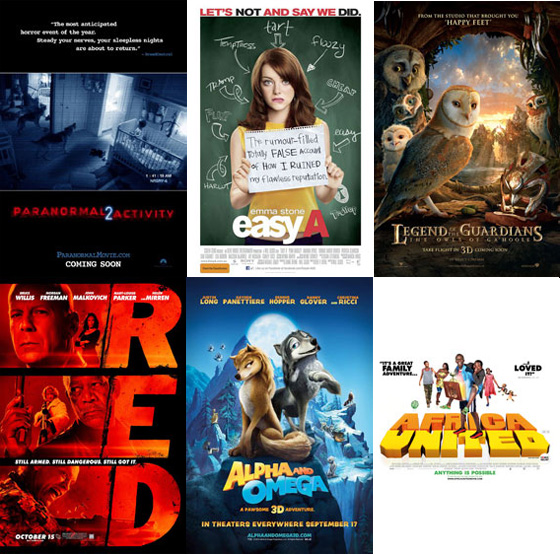
Paranormal Activity 2 (Paramount): The sequel to last year’s low budget horror hit begins 3 months before the haunting of Micah and Katie, the married couple in the first film. It focuses on Katie’s sister who lives in the same neighbourhood and starts to experience similar problems in her house.
Paramount screened this one very late for UK critics, often a bad sign, but it is actually a passable sequel that uses the same bag of tricks as the first one: a central conceit that you are watching ‘found footage’; plenty of scary bumps and a premise which is basically The Blair With Project in a house. Given the low budget, Paramount will be expecting to reap significant profit from this sequel and it may even replace the Saw franchise as a regular fixture around Halloween. [Nationwide / 15]
Legends of The Guardians: The Owls of Ga’Hoole (Warner Bros.): Zack Snyder’s 3D animated debut is about a young barn owl who escapes from an orphanage to the island of Ga’Hoole, where he fights alongside its nobler and wiser elders.
Featuring the voices of Hugh Jackman, Hugo Weaving, Emile de Ravin and Jim Sturgess, it will be shown in 3D and is likely to claim the number 1 spot given its appeal to the half-term family audience. [Nationwide / 15]
Easy A (Sony Pictures): A sharp and surprisingly funny high school comedy about a pupil (Emma Stone) who spreads a rumour about losing her virginity and finds her life resembling Hester Prynne’s in ‘The Scarlet Letter’ – a book she is also studying.
Directed by Will Gluck, it plays like a cross between Mean Girls and Superbad (although not quite as good) with sharp one liners and ribald humour. The supporting cast is very good, featuring Stanley Tucci, Patricia Clarkson and Thomas Haden Church. [Nationwide / 15]
Red (Entertainment One UK): An action-comedy loosely based on the DC comic book series about a former black-ops agent (Bruce Willis) who reassembles his old team.
Directed by Robert Schwentke, it features an impressive supporting cast which includes Morgan Freeman, Mary-Louise Parker, John Malkovich and Helen Mirren. [Nationwide / 15]
Alpha & Omega (Lionsgate UK): A 3D animated comedy about a pair of wolves (voiced by Hayden Panettiere and Justin Long) who are captured by park rangers and taken far away, where they bond despite their differences.
Directed by Anthony Bell, it also features the voices of Christina Ricci, Danny Glover, Dennis Hopper and Larry Miller. Another film aimed at the lucrative half-term family market. [Vue West End & Nationwide / U]
Africa United (Warner Bros/Pathe): A drama about three Rwandan kids who walk 3000 miles to the World Cup in South Africa during 2008.
Directed by Debs Gardner-Paterso, it stars Eriya Ndayambaje, Roger Nsengiyumva, Sanyu Joanita Kintu, Yves Dusenge and Sherrie Silver. [Nationwide / 12A]
Ramona And Beezus (20th Century Fox): An adaptation of the books from the Ramona series of children’s novels by Beverly Cleary which follows the misadventures of a young pupil named Ramona Quimby (Selena Gomez). [Empire Leicester Square & Nationwide / U]
ALSO OUT
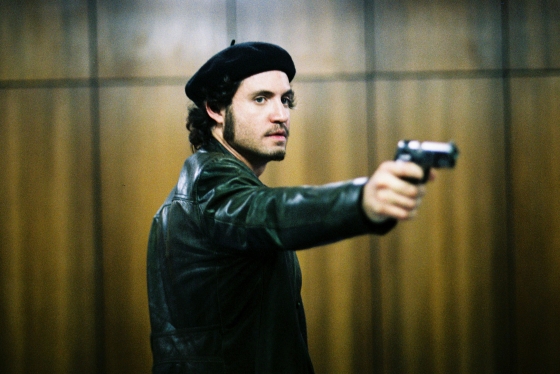
Carlos (Optimum Releasing): An epic project depicting the career of Carlos the Jackal, it brilliantly recreates the life and times of the Venezuelan terrorist (Eduardo Ramierez) to paint a fascinating portrait of a historical figure.
Directed by Olivier Assayas, it charts his early years as a violent revolutionary in Europe with the Popular Front for the Liberation of Palestine (PFLP); his missions for states such as Iraq, Libya and East Germany; an infamous kidnapping of OPEC oil ministers in Vienna in 1975 and his gradual decline as he sought refuge in Eastern Europe, Syria and Sudan, as he struggled to cope with the end of the Cold War before finally being caught by French agents in 1994.
An ambitious French TV project, it is getting two kinds of theatrical release: a three part five and a half hour cut and a shortened 165 minute version. It will then get released on DVD and Blu-ray soon after along with a variety of on demand options in several countries. [Curzon Mayfair, Picturehouse Greenwich & Nationwide / 15]
Mary & Max (Soda Pictures): A claymation feature film about a tale of friendship between two pen pals: Mary, a lonely, eight-year-old girl living in the suburbs of Melbourne, and Max, a forty-four-year old, severely obese man living in New York. Featuring the voices of Toni Collette, Philip Seymour Hoffman, Eric Bana and Barry Humphries. [Odeon Covent Garden & Selected Key Cities]
The Arbor (Verve Pictures): An avant-garde documentary exploring the life and legacy of Rita, Sue And Bob Too! playwright Andrea Dunbar. [Curzon Renoir, Gate, Odeon Panton St., Ritzy & Key Cities / 15]
Chasing Legends (Arts Alliance); A documentary following the 2009 Tour de France largely through the eyes of riders and staff of the HTC-Columbia team. [Nationwide / 15]
The Stoning Of Soraya M (High Fliers): A drama adapted from French-Iranian journalist Freidoune Sahebjam’s 1990 book La Femme Lapidée, based on a true story. Directed by Cyrus Nowrasteh, it stars Shohreh Aghdashloo, Jim Caviezel and Mozhan Marnò. [ICA Cinema & Selected Key Cities]
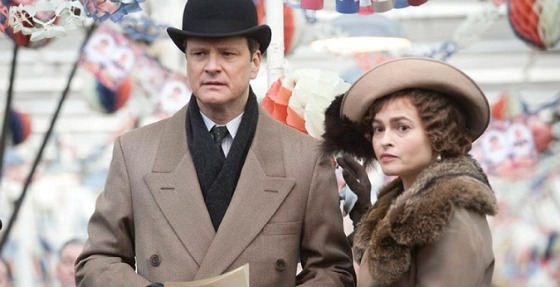
A superbly crafted period drama about the relationship between King George VI and his speech therapist provides a memorable showcase for its two lead actors.
Beginning in 1925, the film traces how with Prince Albert (Colin Firth), The Duke of York, enlisted the help of an unconventional speech therapist named Lionel Logue (Geoffrey Rush), who helped him overcome a crippling stammer as he eventually assumed the throne and helped rally his people during World War II.
The bulk of the film explores the relationship between the stiff, insecure monarch and the charmingly straightforward Logue, his loving and supportive wife Elizabeth (Helena Bonham-Carter) and the royal relatives who may have contributed to his problem.
Having spent his life in the shadow of his domineering father, George V (Michael Gambon), the shy Albert struggles with the responsibility of assuming the throne when his headstrong brother, Edward (Guy Pearce), decides to abdicate.
The screenplay by David Seidler deftly weaves these domestic tensions with the wider drama of the challenges of speaking in public, as the development of radio and newsreels create new expectations and pressures.
It is to director Tom Hooper’s credit that he keeps focused on the relationships at the heart of the film and steers well clear of the ponderous self importance that can afflict British period dramas.
Much of the appeal lies in the culture clash between Lionel and Albert: the Australian-born failed actor and the heir to the throne make for an amusing odd couple, but the connection they gradually form over the years is believable and touching.
Their sequences provide an impressive showcase for the two lead actors: Firth convincingly depicts the underlying frustration and pain of someone suffering a stammer, whilst Rush is delightfully irreverent as the one person who can engage him.
Firth seems to have been re-energised by his work in last year’s A Single Man.
Although this role might seem like a return to the repressed English gentleman he was often typecast as, he brings real nuance and feeling to the role, which could have easily slipped into cliched bluster.
Rush is magnetic as an eccentric whose wit and empathy gradually erode the aristocratic barriers blocking his patient.
Combined, their chemistry is a joy to watch as they depict the social hangups of the British class system as they gradually form a deep bond.
In supporting roles the standouts are Bonham-Carter, who is pleasingly restrained and dead-pan; Michael Gambon as an imposing George V; Guy Pearce as the smarmy Edward and Jennifer Ehle as Lionel’s loving wife.
Hooper demonstrated with his work on HBO’s John Adams that he has a great eye for period detail and the interior lives of historical figures: he achieves the same level of intimacy here with the main characters and crafts a believable recreation of the era.
Danny Cohen’s camera work is a key part of this, artfully framing the characters with a wide lens, whilst also using a Steadicam to give certain sequences an intriguingly fluid feel for a period piece.
The technical contributions across the board are excellent: Tariq Anwar’s crisp editing keeps things moving smoothly; Eve Stewart’s production design is richly detailed and the costumes by Jenny Beaven are first rate. (The only slight lapse is some CGI work near the end).
‘Crowd-pleaser’ is a term that can often signify something sentimental, but The King’s Speech is likely to give a lot of pleasure to audiences across a wide spectrum.
An astutely observed social comedy, it also has great depth as a drama, beginning and ending with sequences of considerable weight and tension.
The film has already proved a hit on the festival circuit this year and it is very hard to see audiences and Oscar voters resisting its classy blend of history, humour and emotion.
The King’s Speech premieres at the London Film Festival tonight and screens on Friday 23rd and Saturday 24th. It opens in the UK on January 7th 2011.
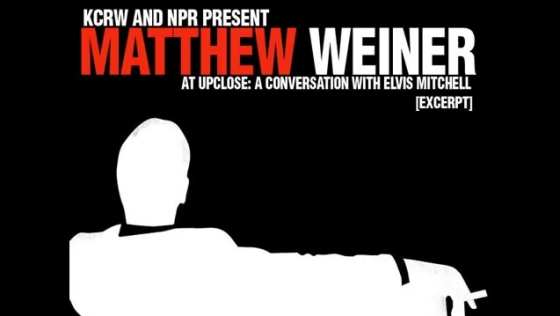
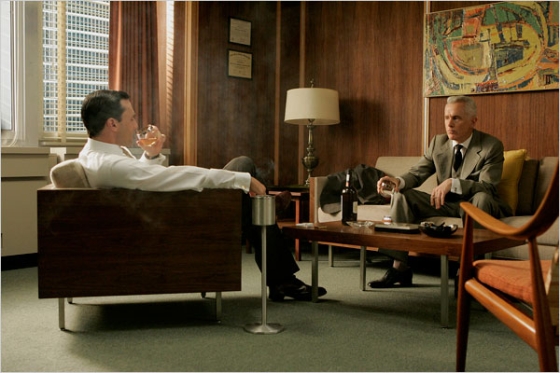
The discussion is nearly an hour long and touches on various aspects of the show, including: his work on The Sopranos and how it connected to Mad Men; how he cast Jon Hamm as Don Draper; the fact that a lot of the cast are from the Midwest; his background growing up in California; and the influence of Carnal Knowledge (1971).
Director Anton Corbijn has made the world’s “smallest and shortest film” for the Dutch postal service TNT, from an idea by creative agency KesselsKramer.
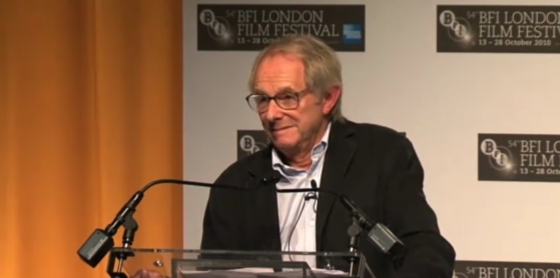
Ken Loach recently gave a keynote speech at the London Film Festival where he discussed the current state of British cinema and the role of the national broadcasters in supporting a healthy UK film culture.
Here are some edited highlights:
You can watch the full speech at BFI Live by clicking here.
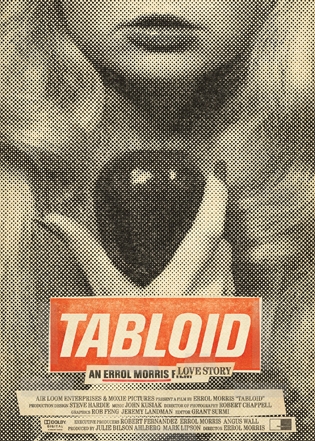
A former beauty queen, a Mormon missionary, British tabloid newspapers and cloned dogs all provide Errol Morris with some riotous material for his latest documentary, which ranks alongside his finest work.
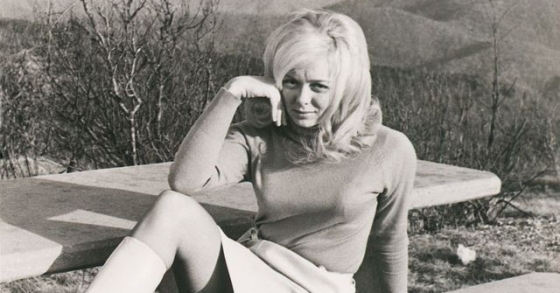
In the late 1970s when a former Miss Wyoming named Joyce McKinney, caused a tabloid scandal in England by allegedly kidnapping a Mormon missionary in Surrey and ‘enslaving’ him in an episode which was soon dubbed the ‘Mormon sex in chains case’.
The resulting media feeding frenzy increased when she was arrested and imprisoned only to later escape to the US, where she surfaced many years later in a very different story.
Morris explores this bizarre tale through extended interviews with McKinney herself; Peter Tory, a journalist for the Daily Express close to the story; Kent Gavin, a photographer for the rival Daily Mirror who had a different take on McKinney; Troy Williams, a Mormon activist who provides religious context; and a Korean scientist who clones dogs.
Using his trademark Interrotron camera, which creates the effect of the subject talking at the audience, Morris elicits revealing testimonies which relay events like a compulsive, page-turning novel.
He certainly struck gold in finding McKinney: energetic, talkative and at times seemingly delusional, she has a turn of phrase which is infectious, ridiculous and hilarious.
Providing a nice counterbalance is Tory, who gives a more sober account but also has an intriguing part in the story he reported on.
Not only was he MacKinney’s unofficial ‘minder’ for the Express, accompanying her to a film premiere for publicity, but his recollections are not always what they seem.
Another perspective is provided by Gavin, who as a deadly rival to Tory, embodies the tenacity of old-school Fleet Street veterans. His relish and glee at uncovering certain photos is as revealing as McKinney’s delusions.
But tabloid is more than just the hilarious recollections of a juicy story: it is a shrewd dissection of tabloid culture itself through its use of inventive graphics and judicious editing.
One dazzling technique used throughout is the accentuation of the interviewee’s words with on screen graphics, highlighting the way in which tabloids interpret language for effect.
Morris also uses graphics to visualize the story, as archive tabloid coverage comes alive with headlines, pull-quotes and cartoons cleverly synced with the words we hear from the people on screen.
Seeing the fonts of various English newspapers flash up on screen conveys the hysterical, funny and often cruel nature of how tabloids present information to the world.
It nails the peculiarities of the British tabloid press: the screaming headlines, bitter rivalries, fascination with smut and the overblown, self-important nature of their coverage are all deftly conveyed.
The editing by Grant Surmi is also outstanding and the film flows with consummate ease between the different interviews, often punctuating them with marvellous audio and visual flourishes.
On a deeper level Tabloid is about how stories and events are remembered.
There are different points of view on MacKinney’s story and the film is fascinating precisely because it leaves room for our own conclusions.
Ironically, this is the polar opposite of tabloid coverage which seeks to paint things in black and white, and provide a definitive viewpoint on even the most contentious of matters.
Morris takes quite the opposite approach and by probing the details of this odd case, appears to suggest that the attention seeking subject reflects the very culture that showcased her.
But Tabloid is by no means a cerebral, academic exercise.
One of the most purely entertaining documentaries in years, it makes you think whilst you laugh and is another reminder of why Errol Morris remains one of the best filmmakers working today.
Tabloid played at the London Film Festival over the weekend but a UK release date is TBC
Mike Leigh’s latest film is a pitch-perfect ensemble piece revolving around the friends and family of an ageing married couple.
Nearing retirement age, Tom (Jim Broadbent) and Gerri (Ruth Sheen) live in North London and seem genuinely happy as they work, tend to their allotment and play host to an array of characters who come in and out of their lives.
These include: their son Joe (Oliver Maltman), who is still close to them; Mary (Lesley Manville), a needy divorcee with relationship problems; Ken (Peter Wight), an old friend with a taste for food and alcohol; and Katie (Karina Fernandez), a therapist who forms a relationship with Joe.
Each section of the film is titled with a season and as they change, so do the characters to varying degrees as they deal with the stuff of life: love, death, humour, despair, loneliness and friendship.
It follows the familiar Leigh formula of finding drama in lives of distinctive characters in a particular setting and, like his previous films, relies heavily on the actors to make it work.
The good news is that nearly all the cast bring something distinctive to their roles, creating a rich tapestry of emotions and memorable situations.
Broadbent and Sheen play their couple with just the right amount of affection and tenderness. Their deep love for one another, shown through subtle body language and speech is so good you might not notice it at first.
Lesley Manville is especially outstanding in what initially might seem a clichéd role. But as the film progresses, she conveys the piercing frustrations of her life whilst also managing to be funny, annoying and sympathetic, in what is one of the performances of the year.
The other supporting actors also fill into their roles with an ease which is often a hallmark of a Leigh ensemble and there are also small but perfectly formed turns from Imelda Staunton and Phil Davis.
Not every character is minutely dissected, nor has their conflicts neatly resolved, but we get to observe them at close quarters as time gradually changes their lives, for the better or worse.
Small talk is present in much of the dialogue, but Leigh finds a way to make it revealing, as people either gradually get to the point or reveal their true feelings with a look or gesture.
This means that everyday locations are a theatre of emotions: a dinner featuring Joe’s new girlfriend is awkwardly hilarious; a living room after a funeral becomes a sombre venue for old family tensions; an allotment in the rain seems like the happiest place for a family to be.
Mainstream cinema can be a medium prone to the obvious and bombastic, but the subtle drama Leigh shapes in this film is a master class in exploring the emotional temperatures of everyday life.
These qualities are mirrored in the quietly excellent technical contributions, which feature Dick Pope’s lean and elegant cinematography and Simon Beresford’s convincing but unobtrusive production design.
After coming out of Another Year, it was hard not to think of Secrets and Lies (1995), which, in an already acclaimed career, was arguably Leigh’s creative and commercial high point to date.
The humanity and sheer pleasure of that film is mirrored in his latest, a wonderfully executed exploration of the ups and downs of everyday existence.
Another Year screens at the London Film Festival this week (Mon 18th-Weds 20th) and opens in the UK on Friday 5th November
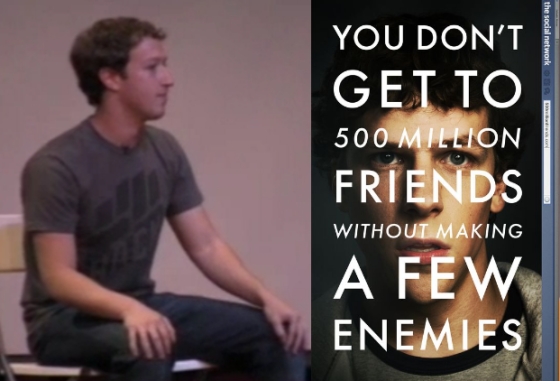
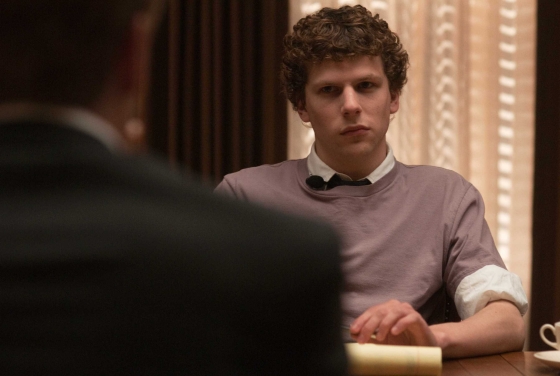
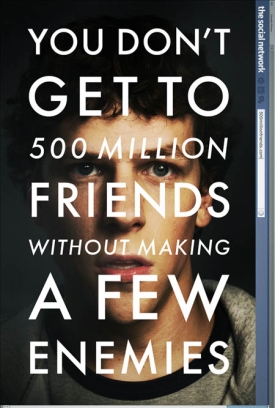
Mark Zuckerberg recently spoke to a group of budding entrepreneurs at Stanford University where he gave his opinions on The Social Network.
Although he initially said that he wouldn’t see the film, he relented and then booked out an entire cinema for the whole of Facebook to see it on the opening day of release.
So what did he think of Hollywood’s version of himself and the company he founded?
He was impressed with the costume department:
It is interesting what stuff they focused on getting right. Every single shirt or fleece in that movie is actually a shirt or fleece that I actually own.
But he was not happy with the opening sequence and the ‘framing’ of the story:
The whole framing of the movie, the way that it starts is that I’m with this girl who doesn’t exist in real life, who dumps me – which has happned in real life a lot.
And basically they frame it as if though the whole reason I invented Facebook and building something was that I wanted to get girls or get into to some social institution. The reality for people who know me is that I’ve been dating the same girl since before I started Facebook.
But I think its just such a big disconnect I think from the way people who make movies think about what we do in Silicon Valley, building stuff. They just can’t wrap their head around the idea that someone might build something because they like building things.
The geeky call to arms elicited some wildly enthusiastic applause from the audience.
Aaron Sorkin might disagree with this version of events as Zuckerberg did blog about a girl named Jessica Alona whilst he created the FaceMash (the hacking prank which led to TheFacebook) and this was incorporated into the film.
Below is the transcript which Sorkin based the scene on:
However, Sorkin changed Alona’s name to ‘Erica Albright’ (the character played by Rooney Mara) and has explained that he did this for a reason:
“There was nothing in the movie that was invented for the sake of making it sensational. There was nothing in the movie that was Hollywood-ized. There are a couple cases where when it didn’t matter at all, I conflated two characters. There are three cases where I changed a character’s name. One of those characters we never actually see; it’s an off-screen character. In the other two cases it’s just there was no need to embarrass this person more. You have the exact same movie and the exact same truth if you don’t do that. So don’t do that.”
So, whilst there almost certainly was a Jessica Alona, she remains an enigma and has never gone public or given an interview.
As for Zuckerberg’s claim that he was dating his current girlfriend before Facebook even started, that has been hotly disputed.
You can watch the full Stanford interview with Zuckerberg here:
An epic project depicting the career of an international terrorist, Carlos is one of the most riveting films in recent memory.
Director Olivier Assayas has brilliantly recreated the life and times of the Venezualan revolutionary (Eduardo Ramierez), born Ilich Ramirez Sanchez and later nicknamed ‘Carlos the Jackal’, to paint a fascinating portrait of a historical figure.
It charts his early years as a violent revolutionary in Europe as he proves his worth to the Popular Front for the Liberation of Palestine (PFLP); missions for states such as Iraq, Libya and East Germany; an infamous kidnapping of OPEC oil ministers in Vienna in 1975 and his gradual decline as he sought refuge in Eastern Europe, Syria and Sudan as he struggled to cope with the end of the Cold War before finally being caught by French agents in 1994, where he currently resides in jail under a life sentence.
An ambitious French TV project, it is getting two kinds of theatrical release: a three part five and a half hour cut and a shortened 165 minute version.
It will then get released on DVD and Blu-ray soon after along with a variety of on demand options in several countries.
Despite its origins, it was shot on 35 mm film and to all intents and purposely feels like a sprawling historical epic. Assayas doesn’t just recreate the period, he plunges us head first in to the era with an exhaustive attention to detail.
The production design is especially outstanding, with costumes, locations and sets all used to present the period with remarkable authenticity.
At the centre of all this is a captivating central performance from Ramierez, who not only bears an eerie resemblance to Carlos, but anchors the film as it criss-crosses through many years and locations: he captures the vanity, obsession and physique of the man rarely in a portrayal that rarely hits a wrong note.
The supporting performances are also strong with stand out turns from Juana Acosta (as an early lover); Alexander Scheer (playing his longest serving colleague) and Nora von Waldstätten (as his increasingly beleaguered wife).
Discerning viewers should catch the full version as the editing gives sequences a fluid sense of movement and pace which belies its long running time. Although the third part sags a little compared to the first two, it moves with an incredible fluency and pace which makes many 90 minute films seem ponderous by comparison.
Some memorable set pieces include his first mission, a botched airport attack, a betrayal, an extended kidnap sequence and the final entrapment of Carlos as the net gradually closes in.
Based on extensive research, with the filmmakers allowing for an interpretation of some events, the attention to detail reaps rich dividends because it never feels burdened by obvious movie tropes.
Many sequences are intercut with news footage from the time, which provide a counterpoint to the perspective of Carlos and his inner circle, as well as rooting us in the historical record.
The handheld cameras and sound design all helps give the action an added urgency which is tingling throughout, and neatly conveys the anxieties of a life on the run.
Also interesting is the widescreen lensing by Yorick Le Saux and Denis Lenoir: some sequences have an epic feel which is contrasted with others that are more much claustrophobic and intimate. Throughout the visuals are handled with a dynamism and skill rare in modern cinema.
In the last decade the gap between television and cinema has narrowed. Not only have higher end shows become more like films, but cinema has struggled to compete with the range and narrative scope offered by series like The Wire and Mad Men.
Carlos represents an interesting hybrid: it screened at Cannes just before premiering on Canal+ in France but in many countries will be seen as three part film project.
It is very hard to imagine a US or UK broadcaster (even HBO or BBC) making a project as ambitious as this: not only is the protagonist a revolutionary terrorist, but it makes no concessions to being obviously ‘prestigious’ or uplifting, in the conventional sense.
But the lift comes from the audacious way in which Assayas and his creative team have relentlessly focused on a character who in some ways, reflects the creeping ambiguities and dangers of modern terrorism.
Although a period piece, Carlos asks awkward questions about the nature of terrorists and does so by featuring an enigmatic central figure: What made a Venezuelan Marxist so passionate about the Palestinian cause? How much of his motivation was vanity over ideology? Is terrorism at its core, a form of narcissism? In what way do nation states use terrorists for their own ends?
These are never fully answered but teased out for audiences to form their own perspective. A running theme seems to be that Carlos was both a practical tool used by various governments complicit in his activities (such as Iraq, Libya) but also a useful myth whose frequently botched acts were more about perception than reality.
This is contrasted with his own motivations, which often seems to be an egotistical individualism at odds with his professed solidarity to the global Marxist struggle.
As the film draws to a close and Carlos becomes like a faded rock star shunned from countries once sympathetic to him and his mystery actually deepens as the enigma fades.
Had he merely stopped serving a purpose after the Cold War ended? Or was it merely a matter of time running out and his crimes catching up with him? Was Carlos an individual who hijacked causes for his own egotistical ends?
The questions are tantalising and although after five and a half hours the audience might be expecting some answers, the film is satisfying precisely because it avoids lazy conclusions, almost reflecting the mysteries and myths that grew around the man himself.
The use of post-punk and new wave songs (especially Wire’s anthem Dot-Dash) provide bursts of energy throughout, whilst the lack of a conventional score infuses others with a raw sense of immediacy and tension.
A mammoth logistical undertaking compressing over thirty years of history into around 330 minutes, Carlos is also an absorbing portrait of a mythological figure, who seems to embody the unsettling mysteries and reality of terrorism.
More than just an accomplished historical biopic, it is also an essential drama about the times in which we live.
Carlos screened at the LFF on Saturday and Olivier Assayas gives a screen talk on Saturday 24th October
** The extended and abridged versions will both be released at UK cinemas on Friday 22nd October **
Amores Perros (Optimum): The feature film debut of director director Alejandro Gonzalez Inarritu is a riveting tale of three interlocking stories that revolve around a car crash in Mexico City. The first section sees Octavio (Gael García Bernal) try to arrange a dog fight so he can run away with his girlfriend Susana (Vanessa Bauche).
The next shows Daniel (Álvaro Guerrero), a wealthy publisher, move in with his housebound younger lover Valeria (Goya Toledo), as her pet dog gets lost under the floorboards of their apartment. The final segment features El Chivo (Emilio Echeverria), an older homeless man trying to contact his daughter, who he hasn’t seen in years. [Read the full review here] [Blu-ray / DVD]
ALSO OUT
Bean – The Ultimate Disaster Movie (Universal Pictures) [Blu-ray / 20th Anniversary Edition] Black Death (Sony Pictures Home Ent.) [Blu-ray / Normal] Bones: Season 5 (20th Century Fox Home Ent.) [Blu-ray / Normal] Born to Raise Hell (Optimum Home Entertainment) [Blu-ray / Normal] Brooklyn’s Finest (Momentum Pictures) [Blu-ray / Normal] Chitty Chitty Bang Bang (20th Century Fox Home Ent.) [Blu-ray / with DVD] Driven to Kill / The Keeper / Born to Raise Hell (Optimum Home Entertainment) [Blu-ray / Box Set] Frozen (Momentum Pictures) [Blu-ray / Normal] Grand Canyon Adventures – River at Risk (Cornerstone Media Int.) [Blu-ray / with 3D Version] Mr Bean’s Holiday (Universal Pictures) [Blu-ray / 20th Anniversary Edition] Nausicaa of the Valley of the Wind (Optimum Home Entertainment) [Blu-ray / Normal] Professor Layton and the Eternal Diva (Manga Entertainment) [Blu-ray / with DVD] Ran (Optimum Home Entertainment) [Blu-ray / Normal] Robocop / Robocop 2 / Robocop 3 (20th Century Fox Home Ent.) [Blu-ray / Box Set] Room in Rome (Optimum Home Entertainment) [Blu-ray / Normal] South Pacific (20th Century Fox Home Ent.) [Blu-ray / Normal] Suck (Universal Pictures) [Blu-ray / Normal] Supernatural: The Complete Fifth Season (Warner Home Video) [Blu-ray / Normal] The Collector (Icon Home Entertainment) [Blu-ray / Normal] The Deer Hunter (Optimum Home Entertainment) [Blu-ray / Normal] The Experiment (Momentum Pictures) [Blu-ray / Normal] The Ladykillers (Optimum Home Entertainment) [Blu-ray / Normal] The Lost Boys 3 – The Thirst (Warner Home Video) [Blu-ray / Normal] The Rocky Horror Picture Show (20th Century Fox Home Ent.) [Blu-ray / Normal] The Tortured (E1 Entertainment UK) [Blu-ray / Normal] THX 1138 (Warner Home Video) [Blu-ray / Normal] Timecop (Warner Home Video) [Blu-ray / Normal] V: The Complete First Season (Warner Home Video) [Blu-ray / Normal] Van Gogh: Brush With Genius (Cornerstone Media Int.) [Blu-ray / Normal] Zombies of Mass Destruction (Optimum Home Entertainment) [Blu-ray / Normal]
Three stories converge through a car crash in this brilliantly executed drama set in Mexico City.
Amores Perros (2000) was the debut feature of director Alejandro Gonzalez Inarritu and screenwriter Guillermo Arriaga, set the template for their subsequent collaborations – 21 Grams (2003) and Babel (2006) – by exploring intense human behaviour through a non-linear narrative.
The first section sees Octavio (Gael García Bernal) try to arrange a dog fight so he can run away with his girlfriend Susana (Vanessa Bauche).
The next show Daniel (Álvaro Guerrero), a wealthy publisher, move in with his housebound younger lover Valeria (Goya Toledo), who sees her pet dog get lost under the floorboards of their apartment.
The final segment features El Chivo (Emilio Echeverria), an older homeless man trying to contact his daughter, whom he hasn’t seen in years.
A startling feature debut for Inarritu, it deservedly reaped a lot of critical aacclaim on its release in 2000 and ended up with an Oscar nomination for Best Foreign Film.
The dark exploration of human and animal behaviour is a riveting watch, with fine performances from the ensemble cast – even the dogs are great.
The graphic dog fights disturbed some viewers, who suspected they were done for real, but a short featurette explains how they achieved these sequences without harming any animals.
When it was first released, some pointed out the narrative similarities to Pulp Fiction (1994), but Innaritu stamps the material with his own style and energy, creating a searing examination of life at the margins of a city.
In some ways it is still his most vital and stylish film, which marked the arrival of a major cinematic talent.
A New Yorker recently attached a video camera to a helium balloon and launched it into the atmosphere.
Luke Geissbuhler and his son Max from Brooklyn, launched the ‘space balloon’ which rose 19 miles above the earth and captured some remarkable footage, which you can see in this annotated video:
The Social Network (Sony Pictures): David Fincher’s latest film is an absorbing drama about the battles amongst the founders of social networking website Facebook.
It begins with Harvard student Mark Zuckerberg (Jesse Eisenberg) getting dumped by a girl (Rooney Mara) which prompts him to hack in to the campus computer network as revenge, whilst blogging about his reasons for doing so.
This brings him to the attention of Cameron and Tyler Winklevoss (played by Armie Hammer) and Divya Narendra (Max Minghella), who approach him with the idea of a social network site, but Zuckerberg opts to create his own version with the help of his friend Eduardo Severin (Andrew Garfield).
Originally called TheFacebook it is an instant success at Harvard and campuses across the US, which leads Zuckerberg to California where entrepreneur and Napster co-founder Sean Parker (Justin Timberlake) helps him approach investors.
The narrative is intercut with flashforwards to various legal depositions, in which characters explain the conflicts which would later arise, with the Winklevoss twins and Narenda claiming Zuckerberg stole their idea, whilst Severin (who initially bankrolled the site) falls out with Zuckerberg over Parker’s influence.
This might not initially sound like the most exciting or dynamic material for a film, but with an A-list roster of talent behind the camera – director Fincher, screenwriter Aaron Sorkin and producer Scott Rudin – the end result is a stimulating tale of human relationships gone wrong and a wonderfully crafted production.
It has already got rave reviews in the US and a wave of Oscar buzz, which is richly deserved as it is one of the best films to come out this year. Sony will be hoping there is enough buzz and anticipation to fend off competition from Despicable Me but this is likely to draw audiences over the coming weeks. [Nationwide / 12A]
Despicable Me (Universal): An animated film about a supervillain named Gru (Steve Carell) who tries to use three orphans girls as pawns for a grand scheme, only to find that their innocence changes him.
Featuring the voices of Jason Segel, Russell Brand, Julie Andrews, Will Arnett, Kristen Wiig, and Miranda Cosgrove it was a big success in the US earlier this summer, scoring solid reviews in the process and marks the first CGI feature produced by Universal. [Empire Leicester Square & Nationwide / Scotland from October 11th]
Vampires Suck (20th Century Fox): A parody of the Twilight series from the people who brought us comedies such as Date Movie, Epic Movie, Meet the Spartans, and Disaster Movie.
The critical revulsion that greeted this film in the US will likely be repeated over here. [Empire Leicester Square & Nationwide / 12A]
ALSO OUT
Over Your Cities Grass Will Grow (Artificial Eye): A documentary about artist Anselm Kiefer’s studio in Barjac in France, where he bought a derelict silk factory and transformed it into an existing artistic centre. Directed by Sophie Fiennes. [Cine Lumiere, Gate & selected Key Cities / U]
Aakrosh (Eros): Action-thriller film directed by Priyadarshan and starring Ajay Devgn, Akshaye Khanna, Bipasha Basu, Paresh Rawal and Reema Sen. [Cineworlds Feltham, Ilford, Shaftesbury Ave., Wood Green & Key Cities]
Knock Out (Eros): A Bollywood film – that may or may not be a remake of Phone Booth – directed by Mani Shankar, and stars Sanjay Dutt, Irfan Khan and Kangna Ranaut. [Cineworlds Feltham, Greenwich 02, Ilford, Wood Green & Key Cities]
The film adaptation of Kazuo Ishiguro’s novel is an exquisitely crafted but emotionally distant meditation on mortality.
Set in an alternate timeline of England where science has cured many illnesses, a young woman named Kathy (Carey Mulligan) looks back on her childhood when she grew up with two friends, Ruth (Keira Knightley) and Tommy (Andrew Garfield).
As youngsters they attend Hailsham, a boarding school sheltering them from the outside world, and as they grow older it slowly dawns on them that they have been excluded from mainstream society for a reason.
From the opening credits director Mark Romanek establishes a carefully controlled mood, and for the early section we see younger actors (Isobel Meikle-Small, Ella Purnell and Charlie Rowe) convincingly play the three leads as children in 1978.
Hints are dropped fairly early on about the mysterious nature of their youth, alongside a developing love triangle as Kathy realises Tommy, who she bonded with from an early age, is in love with Ruth.
The recreation of an ageing English boarding school is thoroughly convincing, with some first rate costume and production design, and the transition to their teenage years in the mid-1980s is fairly seamless.
Romanek handles the material with considerable skill and technically the film is exquisitely made: Adam Kimmel’s widescreen cinematography and Barney Pilling’s editing all help to create a rich mood of sadness and regret.
As an American, Romanek was an interesting choice to direct the material and he gives it a crisp sense of movement, far removed from the ponderous nature of many British productions which can drearily linger on their period settings.
The alternative version of England is depicted with unusual precision.
Look carefully at the school, the countryside, the towns and vehicles and you will notice a piercing eye for detail, which enhances the realism despite the sci-fi backdrop.
There are also some memorable images: the creepy beauty of Hailsham, the wintry isolation of an empty beach and the clinical interiors of a hospital are just some of the startling visual backdrops.
Added to this is a standout central performance from Carey Mulligan. Her work here is on par with her lauded turn in ‘An Education’, demonstrating a rich vein of emotion along with a captivating screen presence.
As the film moves in to the 1990s, she depicts a maturity beyond her years, perfectly suited to the material, and also delivers a potentially tricky voiceover with just the right nuance and feeling.
But there is a paradox at the heart of Never Let Me Go, which is that for all its impeccable craft, there is an emotional distance to the audience.
Alex Garland’s screenplay, which otherwise does a fine job at extracting and shaping the ideas of the book, shows its hand early on, so there is a sense of inevitability to the story.
Whilst this emphasises the notion of fate, it also means the revelations are blunted and end up lacking an intellectual and emotional force.
This is typified in Rachel Portman’s lush orchestral score which despite containing beautiful flourishes, is deployed too heavily throughout, and ends up blending into a collective sound of despair.
Added to this, there is no escaping that the material is an emotional downer: a reminder of the transience of existence, it goes against the feel-good optimism of many mainstream releases.
This is actually to its credit, as precious few films even attempt this, but it may be a reason audiences either don’t respond or simply stay away.
In the language of the film it has already ‘completed’ and this is disappointing, as films displaying this level of craft deserve a better fate.
I suspect some US audiences were instinctively repelled by the way in which the characters ‘accept’ their condition.
This is of course an underlying theme of the novel and film – that human beings resign themselves to social conditioning – but it clearly hasn’t caught the mood, even amongst more discerning audiences.
Certainly a film about death, which focuses on the underlying cruelty of a society dedicated to the greater good, is a tricky sell in an era of recession and general gloom.
Time may be kinder to Never Let Me Go.
Despite certain shortcomings, it is a worthy adaptation which conveys the profound sadness of the novel and marks a welcome return for Romanek to the director’s chair.
Never Let Me Go opened the London Film Festival tonight and opens in the UK on Friday 21st January 2011
New video has surfaced of Eric Stolz as Marty McFly in Back to the Future.
Included on the forthcoming Blu-ray special edition of the 1985 time-travel comedy, it features director Robert Zemeckis, along with producers Frank Marshall and Steven Spielberg, explaining the decision to replace Stolz with Michael J Fox.
Zemeckis then convinced Universal – who would’ve cancelled the production if it didn’t meet their deadline – to re-shoot five weeks worth of footage with Fox, who somehow combined the role with working on the TV show ‘Family Ties’.
Stoltz went on to star in films such as The Fly II (1989) and Pulp Fiction (1994) and more recently has moved into directing television shows such as Law & Order, Grey’s Anatomy and Glee.
The Back to the Future trilogy is out on Blu-ray on Monday 25th October
David Fincher’s latest film is an absorbing drama about the battles amongst the founders of social networking website Facebook.
It begins with Harvard student Mark Zuckerberg (Jesse Eisenberg) getting dumped by a girl (Rooney Mara) which prompts him to hack in to the campus computer network as revenge, whilst blogging about his reasons for doing so.
This brings him to the attention of Cameron and Tyler Winklevoss (played by Armie Hammer) and Divya Narendra (Max Minghella), who approach him with the idea of a social network site, but Zuckerberg opts to create his own version with the help of his friend Eduardo Severin (Andrew Garfield).
Originally called TheFacebook it is an instant success at Harvard and campuses across the US, which leads Zuckerberg to California where entrepreneur and Napster co-founder Sean Parker (Justin Timberlake) helps him approach investors.
The narrative is intercut with flashforwards to various legal depositions, in which characters explain the conflicts which would later arise, with the Winklevoss twins and Narenda claiming Zuckerberg stole their idea, whilst Severin (who initially bankrolled the site) falls out with Zuckerberg over Parker’s influence.
This might not initially sound like the most exciting or dynamic material for a film, but with an A-list roster of talent behind the camera – director Fincher, screenwriter Aaron Sorkin and producer Scott Rudin – the end result is a stimulating tale of human relationships gone wrong.
It is also a very interior film, with much of the action taking place inside dorm rooms and legal offices, but Sorkin’s script does an excellent job at rattling through the events and digging out some juicy drama.
His sculpted rat-a-tat dialogue provides a mixture of humour, pathos and insight in presenting what Facebook did to the founders, plus the overall ironies for them and the wider culture that embraced it.
Whilst he has expressed doubts about the web and new technology, Sorkin is perfectly suited to this material.
As a more traditional writer, he mines the old fashioned themes of envy, jealousy and ambition inherent in the story, but from a distance which allows him to probe the social cost of relationships online.
David Fincher might also seem a counter-intuitive choice, but aside from directing with his customary skill and taste, he manages to ramp up the drama by keeping things simple and focused.
Compared to his previous work it moves quickly and the editing and structure all ground the information in a tight and engrossing package.
Fincher’s customary dark visual palette is on display again, but the balanced compositions from cinematographer Jeff Cronenweth nicely dovetail the crispness of the digital images (which were shot on the Red One digital camera).
Their compelling soundscape of samples and beats gives the film a distant and offset mood, which may or may not be a reflection of Zuckerberg’s personality.
In a film filled with fine performances, Jesse Eisenberg is the stand out with a focused and at times mesmerising portrait of Zuckerberg as an awkward, brilliant and driven individual.
It might not be as accurate as some have claimed but it captures the restless energy and intelligence that drove Facebook in its messy early years and kept it from being sold off (and ruined) too soon.
Garfield paints a convincing picture of a wronged friend unable to keep up with events, whilst Timberlake is charming as the one person who appreciates Zuckerberg’s idea of how big Facebook can actually be.
The Winklevoss twins – or “Winklevii” as Zuckerberg dismisses them at one point – are actually played by one actor, a feat achieved with considerable technical aplomb by both Armie Hammer and Fincher’s visual effects team.
Representing old school privilege, they also feature in a perfectly executed scene when they try to convince the then Harvard president Lawrence Summers (Douglas Urbanski) that Zuckerberg has stolen the site from them.
The dialogue, acting and direction frequently paint a telling clash between the traditional world unable to comprehend the new paradigm represented by upstarts in Silicon Valley.
Whatever the veracity of the sources used to inspire the film, and Ben Mezrich’s book on which it was based has been criticised, it is structured so that the audience can draw their own conclusions from the various perspectives offered by the Winklevoss twins, Severin and Zuckerberg.
Who comes out best will clearly be a debating point for audiences, but the portrait of Zuckerberg as a social outsider driven by something other than just money is not as unflattering as one might think.
A lot of the debate surrounding the film is the portrayal of Zuckerberg himself.
Although it paints a picture of an intense and potentially haunted individual, you can also see him as an irreverent visionary battling against negativity to build something millions of people use.
There are thematic parallels to Citizen Kane: a young wunderkind creates an empire, has huge ambitions, women issues, breaks up with a friend and collaborator, is left seemingly alone despite creating over millions of virtual connections for other people. (For Rosebud, substitute an ex-girlfriend).
In a sense The Social Network is the cinematic equivalent of a Facebook profile: it uses selected facts to present a portrait of an individual; features potentially embarrassing information; and harvests personal data that will be seen all around the world.
For tech journalists a little too concerned with the details, let’s remember this is a representation of the facts and not a definitive statement.
But like Facebook, it has been assembled with considerable technical skill and may strike a deep chord with audiences hungry to find out more about an online phenomenon so embedded in contemporary life.
How future viewers will judge it is hard to predict, but I suspect two very different perspectives could emerge.
For some it will be the cautionary parable of a website which connected over 500 million virtual friends which also broke up the actual friends that created it.
For others Mark Zuckerberg could become like Gordon Gekko, an unlikely figure of inspiration to a generation who use technology to change old assumptions and beliefs.
With its mix of potent ideas and impeccable craft, it is a likely Oscar contender and deserves the recognition and kudos, as it paints a fascinating picture of age old tensions at the heart of new technology.
The Social Network is out in the UK on Friday 15th October
Last night’s episode of The Simpsons (entitled ‘MoneyBART‘) aired with a surprisingly political intro directed by British street artist Banksy.
Along with references to himself it culminated in an extended sequence referencing reports that the show outsources much of its animation to a company in South Korea.
Although the show has mocked Fox in the past, according to Time magazine, Banksy admitted that the segment resulted in:
‘delays, disputes over broadcasting and even threats of a walk-out from the animation department’
If you think of Fox as an Octupus, The Simpsons would be like one suction cup on one of the tentacles, …so it doesn’t really bother the rest of the octopus.
The fact that it’s one of the most successful shows in television history has also given them a degree of protection.
But even by their own standards, this intro was unusually punchy and also marked the first time an outside artist has contributed to the actual storyboard.
The Exorcist (Warner Bros.): The classic 1973 horror about a young girl (Linda Blair) possessed by an evil spirit and the priests (Jason Miller and Max von Sydow) who try to exorcise the demon, at the request of her distraught mother (Ellen Burstyn).
Directed by William Friedkin, the new Blu-ray features the remastered Director’s Cut and Theatrical Cut along with various featurettes and audio commentaries. [Read the full review here]
The Evil Dead (18): Sam Raimi’s 1981 low budget horror debut is about a group of college kids who make an ill-fated trip to a remote mountain cabin where all hell breaks loose.
Controversial its day, the film still has a demented, raw energy and this Blu-ray features plenty of supplementary material and a brand new audio commentary from director Raimi, actor Bruce Campbell and producer Robert Tapert. [Read the full review here]
30 Days of Night: Dark Days (Sony Pictures Home Ent.) [Blu-ray / Normal] Ben 10: Alien Swarm (Warner Home Video) [Blu-ray / with Digital Copy] Bend It Like Beckham (Lionsgate UK) [Blu-ray / Normal] Carlito’s Way (Universal Pictures) [Blu-ray / Normal] David Attenborough: Planet Earth – The Complete Series (2 Entertain) [Blu-ray / Special Edition Box Set] Devil’s Playground (E1 Entertainment UK) [Blu-ray / Normal] Dollhouse: Complete Seasons 1 and 2 (20th Century Fox Home Ent.) [Blu-ray / Box Set] Goodnight Mister Tom (ITV DVD) [Blu-ray / Normal] Hunt to Kill (Anchor Bay Entertainment UK) [Blu-ray / Normal] Jane Austen Collection (ITV DVD) [Blu-ray / Normal] Lost in Space (Warner Home Video) [Blu-ray / Normal] Lost: The Complete Seasons 1-6 (Walt Disney Studios Home Ent.) [Blu-ray / Special Edition Box Set] MacGruber (Universal Pictures) [Blu-ray / Normal] Monster House (Sony Pictures Home Ent.) [Blu-ray / 3D Edition] Night of the Demons (Kaleidoscope Home Ent.) [Blu-ray / Normal] Ong-Bak: 3 (Optimum Home Entertainment) [Blu-ray / Normal] Rush Hour (Warner Home Video) [Blu-ray / Normal] Sharpe: Classic Collection (ITV DVD) [Blu-ray / Normal] The Losers (Optimum Home Entertainment) [Blu-ray / Normal] The Rolling Stones: Ladies and Gentlemen – The Rolling Stones (Eagle Rock Entertainment) [Blu-ray / Normal] The Smurfs and the Magic Flute (Fabulous Films) [Blu-ray / Normal] The Take (ITV DVD) [Blu-ray / Normal] Ultimate Gangster Collection (Universal Pictures) [Blu-ray / Box Set] Veer (Eros International) [Blu-ray / Normal] Wild Target (EV) [Blu-ray / Normal]
William Friedkin’s classic 1973 film finally gets the Blu-ray treatment from Warner Bros with a disc filled with features.
One of the truly great films of the 1970s, it was adapted by William Peter Blatty from his bestselling novel about a young girl (Linda Blair) in Washington D.C. possessed by an evil spirit.
When her distraught mother (Ellen Burstyn) can find no answers from the medical profession, she turns to a local catholic priest (Jason Miller) and an ageing exorcist (Max Von Sydow).
A box office sensation at the time, it scored several Oscar nominations and became something of a pop-culture phenomenon.
In the UK it has a special aura, as Warner Bros decided to stop releasing it on home video after the ‘video nasties’ scare of the mid-1980s and it only got a re-issued years later in 1999.
A further special edition followed in 2000, with 11 minutes of extra footage trimmed from the original theatrical release.
The film is a victim of its own success, as some modern audiences find certain effects (notably the pea soup vomit) dated and that it doesn’t quite live up to its considerable reputation.
However, The Exorcist is much more than just a horror film. A disturbing drama about the breakdown of a family, the loss of faith and the presence of evil, it taps in to deep, universal fears which even the very best horrors don’t even touch.
Coming off the Oscar winning success of The French Connection, Friedkin was at his creative peak and the realistic approach to the material made for a visceral and riveting experience.
The lead performances are uniformly excellent: Burstyn embodies parental anguish; Blair is remarkable as the possessed youngster; Miller gives a quiet dignity to a priest haunted by guilt; and Van Sydow has tremendous presence in the title role.
For the Blu-ray, Warner Bros have included both versions in a two disc set.
I prefer the original theatrical cut, which feels tighter and more polished, but the additional sequences are interesting to compare.
The image quality of the transfer is excellent and certain scenes looks stunning for a film that is thirty-seven years old.
Friedkin attracted some serious criticism for the Blu-ray of The French Connection, where he altered the colour of the film, even prompting cinematographer Owen Roizman to label it as ‘atrocious’.
Here they seem to have made up and in the liner notes Friedkin states that this Blu-ray was:
”color-timed by the cinematographer Owen Roizman and myself and represents the very best print ever made of ‘The Exorcist”.
Certain sequences have a pristine clarity to them and it is a great showcase for Roizman’s cinematography, which is filled with memorable compositions and images.
Warner Bros Home Entertainment has been forging a reputation as the best studio when it comes to re-releasing classic films and the extras on this disc are plentiful.
It includes all the material from previous DVD versions, such as the audio commentaries and 1998 documentary The Fear of God: The Making of The Exorcist.
The most notable addition is the a 3-part documentary on the film’s production and legacy, featuring on-set footage shot by Owen Roizman, along with as ‘personal message statement’ from Friedkin and a 40-page digi-book with photos and essays.
The full list of extras breaks down like this:
Disc 1: – Extended Director’s Cut (2000) plus Special Features
Commentary by William Friedkin
Raising Hell: Filming the Exorcist – set footage produced and photographed by Owen Roizman, camera and makeup tests, and interviews with director William Friedkin, actress Linda Blair, author/screenwriter/producer William Peter Blatty and Owen Roizman (new; Blu-ray exclusive)
The Exorcist Locations: Georgetown Then and Now – Featuring a tour of the iconic locations where the film was shot (new; Blu-ray exclusive)
Faces of Evil: The Different Versions of The Exorcist – with director William Friedkin and author/screenwriter/producer William Peter Blatty discussing the different versions of the film and featuring outtakes from the film (new; Blu-ray exclusive)
Trailers, TV spots & radio spots from the film’s 2000 release
Disc 2 – Theatrical Cut (1973) plus Special Features
Introduction by William Friedkin
Commentaries: William Friedkin / William Peter Blatty with Special Sound Effects Tests
The Fear of God: 25 Years of The Exorcist [1998 BBC documentary]
Additional interviews with William Friedkin and William Peter Blatty
The Original Cut
Stairway to Heaven
The Final Reckoning
Original ending
Sketches & storyboards
Trailers & TV spots from the 1973 version
The Exorcist is out on Blu-ray from Warner Bros Home Entertainment on Monday 11th October
Narrated by Matt Damon, it features interviews with key politicians, bankers and journalists and arrives as one of the most acclaimed documentaries to come out of this year’s festival circuit.
Ferguson also recently spoke to Variety in Toronto about the film:
Inside Job is showing at selected US cinemas now and opens in the UK on February 18th 2011
I wasn’t sure exactly what this was until reading that the score contains musical palindromes: many of the themes can be played backwards, which mirrors the central story of a man ageing in reverse.